
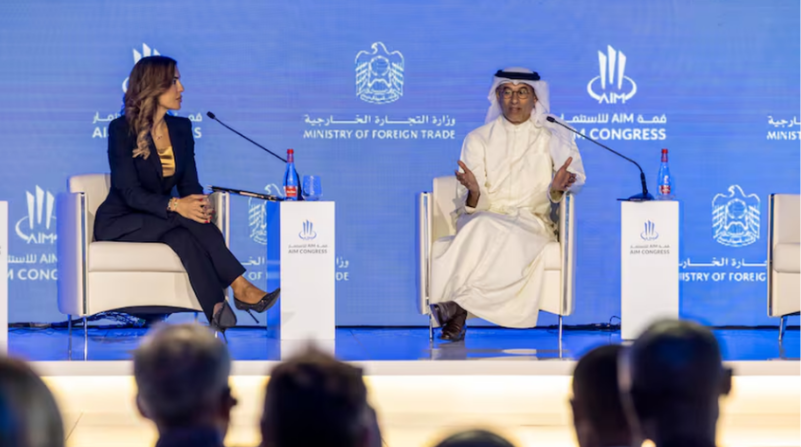
Nice Balance Dubai Property Market Set for ‘Nice Balance’ as 2027 Supply Wave Approaches, Says Emaar Founder Alabbar Dubai Property Market Set for ‘Nice Balance’ as 2027 Supply Wave Approaches, Says Emaar Founder Alabbar Dubai Property Market Set for ‘Nice Balance’ as 2027 Supply Wave Approaches, Says Emaar Founder Alabbar DUBAI — A massive wave of completed homes scheduled to hit Dubai in 2027 will steady property values without triggering a price collapse, Emaar Properties founder Mohamed Alabbar said at the AIM Congress. Alabbar countered forecasts predicting sharp market drops, arguing that incoming residential handovers will curb double-digit inflation and help normalize day-to-day transaction activity across the emirate. “I’m thinking ready for 2027? A lot of supply come in, so people will get nice balances,” Alabbar told attendees. The remarks follow four years of aggressive expansion across Dubai, where off-plan transactions and population influxes pushed both sales figures and rents to record levels. While some brokerages forecast drops reaching 15% as pipeline completions peak, Alabbar labeled those numbers unrealistic. He acknowledged that a minor adjustment of 5 to 10% could materialize if regional instability, specifically US-Iran friction, drags on, but dismissed expectations of a broader downturn. High living expenses and elevated commercial overhead directly hurt Dubai’s appeal to expatriates, Alabbar noted. In his view, cooling current price surges benefits the broader economy because building companies already collect healthy margins. Emaar Rejects Price Cuts External political events and inventory concerns have prompted several competing UAE developers to discount units between 20% and 50% to secure buyers. Alabbar ruled out similar moves for Emaar. “Right now, we have developers who are giving 50% discount, 20% discount. We give no discount,” he stated. Alabbar argued that steep markdowns damage the equity of past buyers and betray balance-sheet weakness. Because Emaar relies on large cash holdings, low debt, and vast land banks, it will keep prices level and depend on its delivery record to close sales. Construction Pipeline and Buyer Cancellations Emaar currently has 90,000 homes under construction across 18 countries, including about 50,000 in the UAE. Alabbar cited recent sales numbers to illustrate buyer reactions during regional military escalations. In normal months, Emaar records roughly 700 cancellations alongside 2,500 sales. When regional tensions peaked, cancellations jumped to 1,100 per month. Once fighting paused, monthly dropouts fell to 550, below standard averages. “Don’t worry about cancellation. That’s just how we do things,” Alabbar said, describing the temporary jump as routine project turnover. While regional uncertainty dampened hotel occupancy and visitor spending, baseline demand for Dubai apartments and villas held firm. Long-Term Strategy Emaar continues to allocate money toward major domestic construction. The company recently committed to a $55 billion project intended for 150,000 occupants, combining residential plots, office space, and road networks. The initiative supports Dubai’s D33 economic program, which seeks to double the city’s economic output and attract fresh workers over the coming decade. For property buyers and lenders tracking project timelines, Alabbar placed the 2027 handover wave in perspective: the arriving properties will not crash developer pricing, but will instead slow down speculation and establish a level footing for the market. Tags Dubai property market Emaar Properties Mohamed Alabbar Dubai 2027 supply Dubai real estate forecast off-plan Dubai Dubai property prices D33 economic agenda AIM Congress

How Will the Al Maktoum Airport Expansion Impact Dubai South Off-Plan Prices in 2026
Table of Contents How Will the Al Maktoum Airport Expansion Impact Dubai South Off-Plan Prices in 2026? Dubai’s skyline has always been shaped by ambition — but what’s happening in Dubai South right now may be the most significant real estate story in the emirate’s history. The AED 128 billion expansion of Al Maktoum International Airport (DWC) is already reshaping property values, transforming a once-peripheral district into the UAE’s next major investment frontier. If you’re watching the Dubai off-plan market and haven’t yet turned your attention to Dubai South, here’s why 2026 may be the year you can’t afford to wait any longer. What Is the Al Maktoum Airport Expansion? Al Maktoum International Airport, also known as Dubai World Central (DWC), has been operational in limited capacity since 2010. That is about to change dramatically. The government-backed expansion, valued at approximately AED 128 billion (USD 35 billion), will transform DWC into one of the largest airports on the planet. When complete, the airport will feature: Five parallel runways Four terminal buildings Over 400 aircraft gates Capacity to handle 260 million passengers and 12 million tonnes of cargo annually To put that in perspective, Dubai International Airport (DXB) currently handles around 90 million passengers per year. Al Maktoum is being built to surpass that three times over — and all aviation operations from DXB are expected to gradually migrate to DWC over time. This is not a distant plan on paper. Contracts are being actively awarded, construction is well underway, and the momentum is already flowing into the surrounding real estate market. What is the Al Maktoum Airport expansion? Al Maktoum International Airport (DWC) is located in Dubai South. The AED 128 billion (~USD 35 billion) expansion will make it the world’s largest airport, with a capacity of 260 million passengers, five runways, and over 400 aircraft gates. All operations from Dubai International Airport (DXB) are expected to shift here gradually over time. How Is the Expansion Already Affecting Dubai South Property Prices? The market has responded decisively — and the data tells a compelling story. Transaction Volumes Have Surged Property transactions in Dubai South exceeded AED 15 billion in just the first five months of 2025 — nearly matching the entire AED 16.1 billion recorded for the full year of 2024. Going into 2026, that momentum has continued to be treated as a structural shift in demand rather than a short-term spike. Prices Have Already Risen 20–25% Since the announcement of the airport expansion, property prices in Dubai South have risen by an average of 20–25%. Analysts at Betterhomes and other leading agencies forecast a further increase of 15–20% in the near term, with steeper appreciation expected as construction milestones are reached. Rental Rates Are Rising in Step It is not just capital values that are climbing. Average annual rents in Dubai South rose by approximately 20% in 2025, driven by growing demand from aviation professionals, logistics workers, and service-sector employees relocating to the area. How much have Dubai South property prices increased? Since the airport expansion announcement, Dubai South property prices have risen by 20–25%. Rental rates also increased by 20% in 2025. In just the first five months of 2025, AED 15 billion in transactions were recorded — nearly matching all of 2024 (AED 16.1 billion). Analysts forecast a further 15–20% appreciation in the near term. The Pricing Gap: Why Dubai South Still Represents Value Despite the recent appreciation, one of the most striking features of the Dubai South market is how much room for growth remains. Current average sale prices in communities adjacent to Al Maktoum Airport: Dubai Industrial City: approximately AED 750 per sq. ft. Dubai Investment Park (DIP): approximately AED 850 per sq. ft. Compare that with established prime districts: Downtown Dubai: AED 2,000–2,500 per sq. ft. Business Bay: AED 2,000–2,500 per sq. ft. That is a pricing gap of roughly 60%. For investors seeking entry into Dubai real estate before appreciation compounds, this differential represents a meaningful opportunity — particularly in the off-plan segment where early-stage pricing and developer payment plans offer additional leverage. First Stone Real Estate currently lists off-plan properties in Dubai South from trusted developers including EMAAR, Danube, DAMAC, and Expo Dubai Group — all active in this corridor. Browse current listings at firststonerealestate.com/communities/dubai-south. What is the price difference between Dubai South and Downtown Dubai? Dubai South currently averages AED 750–850 per sq. ft. for off-plan properties. Downtown Dubai and Business Bay command AED 2,000–2,500 per sq. ft. That makes Dubai South approximately 60% more affordable than prime districts — and the entry window remains open. What Is Driving Long-Term Demand? The Al Maktoum Airport expansion is not simply an aviation story. It is the anchor of a much larger economic ecosystem. One Million New Jobs and Residents The terminal expansion is projected to create employment and housing demand for over one million people, with ripple effects across construction, aviation, logistics, hospitality, retail, and cargo sectors. The aviation sector alone is forecast to contribute more than 30% of Dubai’s GDP by 2030. Dubai South is being master-planned as a self-sufficient city — not a commuter suburb — where people will live, work, and access services within the district itself. The Aerotropolis Effect Major international airports that expand into genuine aerotropolis hubs consistently generate sustained property demand in surrounding areas. Historical precedent is clear: areas near Expo 2020 saw 30–50% price appreciation in the three years following the project announcement. The Al Maktoum expansion is a larger-scale catalyst with longer-term fundamentals. A Buyer Profile That Is Broadening What began as primarily an investor-driven market is now attracting families, aviation professionals, and owner-occupiers seeking well-planned communities with parks, schools, and retail access. Developers such as EMAAR — with 27 active off-plan projects across the UAE — and Danube Properties, known for its accessible 1% monthly payment plan, are actively launching projects in and around Dubai South. Both are available through First Stone Real Estate. Why will long-term demand in Dubai South keep growing?