What's in this guide
It's the first question every international buyer asks — from Mumbai to London to Riyadh: "Can I, as a foreigner, actually own property in Dubai?" The answer is a clear yes, and it has been since 2002. But the details matter: where you can buy, what "freehold" really means, whether you need a visa, what taxes apply (almost none), and what happens to the property after you.
This guide answers all of it, in plain language. It's written by First Stone Real Estate — one of the UAE's best off-plan property specialists. The majority of our clients are international buyers, many of whom complete their entire purchase without ever boarding a flight, so everything below comes from deals we close every week.
Can Foreigners Buy Property in Dubai? What the Law Says
Yes. Since 2002, foreign nationals of any country can buy, own, sell, lease and inherit property in Dubai's designated areas with full 100% freehold ownership — formalised under Law No. 7 of 2006 and Regulation No. 3 of 2006, which list the communities open to foreign ownership. Your name goes on a government-issued title deed from the Dubai Land Department (DLD), exactly like a local owner's.
There are no nationality restrictions, no requirement to have a UAE sponsor or partner, and no limit on how many properties you can own. This is precisely why Dubai became one of the world's most international property markets — and why off-plan launches from developers like Emaar, Damac and Sobha sell to buyers in 100+ countries.
Freehold vs Leasehold vs Usufruct: What's the Difference?
Freehold means you own the property and a share of its land forever; leasehold and usufruct give you long-term rights to use it (up to 99 years) without owning the land. For foreigners in Dubai, freehold is the standard — but you'll see the other terms, especially outside Dubai:
| Freehold | Leasehold | Usufruct | |
|---|---|---|---|
| Duration | Forever (perpetual) | Up to 99 years | Up to 99 years |
| You own | Unit + share of land | Right to occupy the unit | Right to use & benefit |
| Sell / mortgage / inherit | Yes, fully | Within lease terms | Within contract terms |
| Where you'll see it | Dubai designated areas, Abu Dhabi investment zones | Some older Dubai districts | Common in Sharjah for non-GCC buyers |
Where Can Foreigners Buy Property in Dubai? (Freehold Areas)
Foreigners can buy in 70+ designated freehold areas — which today cover almost everything you'd actually want to buy in new Dubai. The reserved (non-freehold) districts are mainly older neighbourhoods like Deira, Bur Dubai and Al Barsha's original villa zones. Here's the freehold map by buyer type:
| If you want… | Popular freehold areas open to foreigners |
|---|---|
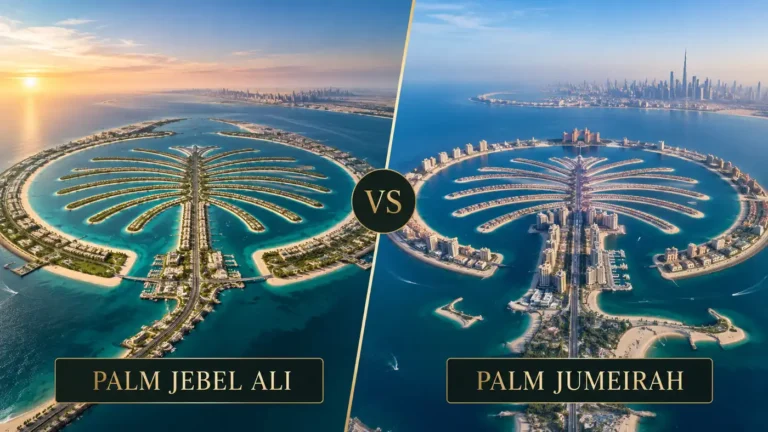
| Iconic / waterfront | Palm Jumeirah, Dubai Marina, Emaar Beachfront, Bluewaters, Dubai Islands, Palm Jebel Ali, Dubai Harbour |
| Central city living | Downtown Dubai, Business Bay, City Walk, Za'abeel, DIFC |
| High rental yields on a budget | JVC, Arjan, Dubailand, Dubai South, Al Furjan, Town Square, Sports City |
| Family villas & townhouses | Dubai Hills Estate, Arabian Ranches, Damac Hills & Lagoons, The Valley, Tilal Al Ghaf, Emaar South |
| Emerging growth corridors | Dubai Creek Harbour, MBR City / Meydan, Expo City, Al Jaddaf, Dubai Maritime City |
Not sure which fits your goal? Our data-led guide to the best areas to invest in Dubai compares yields and growth area by area.
Do You Need a Visa or Residency to Buy Property in Dubai?
No. You don't need a UAE visa, residency or Emirates ID to buy — a valid passport is the only personal document required. You can be on a tourist visa, or not in the country at all. The entire purchase — reservation, Sales & Purchase Agreement, payments and DLD registration — can be completed remotely, either digitally or through a power of attorney held by someone you trust (or by us).
Payments can come from your overseas bank account; a UAE account is convenient but not mandatory. This is how a large share of First Stone's clients buy: we shortlist on a video call, send documents for e-signing, and they receive their Oqood certificate in India, the UK or Saudi without a single flight.
What Documents Do Foreigners Need to Buy?
For a standard off-plan purchase: just your passport copy. That's genuinely it at booking. Along the way you may also need:
- Proof of funds / source of funds — standard KYC for larger transfers (bank statements usually suffice).
- Attested marriage certificate — only if a couple wants joint ownership counted together for a visa application.
- Income documents — only if you're applying for a mortgage (salary certificates or business financials).
- Power of attorney — only if someone signs on your behalf remotely.
For the full purchase journey from booking to title deed, follow our step-by-step guide: how to buy off-plan property in Dubai.
Can Foreigners and Non-Residents Get a Mortgage in Dubai?
Yes. UAE residents (expats) can borrow up to 80% on a ready first home under AED 5M; non-residents can typically get 50–60% from selected banks, subject to income checks. Off-plan financing is capped at 50% for everyone under Central Bank rules — which is why most international off-plan buyers skip the bank and use the developer's interest-free payment plan instead: 5–20% down, the rest in installments, sometimes even after handover.
Does Buying Property Give Foreigners a UAE Visa?
Yes — property is one of the easiest residency routes in the UAE. Two thresholds matter in 2026:
| Investment | Visa | Key points |
|---|---|---|
| AED 750,000+ | 2-year investor residency (renewable) | Single property or combined ownership with spouse (attested marriage certificate); mortgaged property allowed with conditions |
| AED 2,000,000+ | 10-year Golden Visa | Ready or off-plan (off-plan subject to current DLD conditions); covers spouse & children; multiple units can be combined |
The visa is a benefit of ownership, not a requirement for it. Full process, costs and documents here: UAE Golden Visa through property.
What Taxes Do Foreign Property Owners Pay in Dubai?
Almost none — and this is the honest headline that pulls global money to Dubai. For individual owners there is no annual property tax, no capital gains tax, and no tax on rental income in the UAE. What you actually pay:
- One-time 4% DLD fee at purchase (plus small admin charges).
- Service charges — annual community/building maintenance, set per sq.ft by community.
- A small municipality housing fee applied to occupants through DEWA utility bills.
- DET permit fees only if you run short-term holiday rentals.
One honest caveat: your home country may tax your worldwide income or require you to declare overseas property — check your local rules or speak to a tax adviser there. Dubai's side of the equation, however, stays clean.
Can Foreigners Inherit and Pass On Dubai Property?
Yes — foreign-owned property is fully inheritable, and non-Muslim owners can control exactly who inherits by registering a will. Register through the DIFC Wills Service Centre or Dubai Courts, and your property passes per your wishes under your chosen law. Without a registered will, UAE default inheritance rules may apply — a complication nobody wants their family handling from abroad. It's a one-time formality; we connect clients to specialists who handle it in days. (This is general information, not legal advice — confirm specifics for your situation.)
Can Foreigners Buy in Other Emirates Too?
Yes, with different rules per emirate. Abu Dhabi offers freehold to foreigners in investment zones like Yas Island, Saadiyat and Al Reem. Ras Al Khaimah has freehold zones led by Al Marjan Island — currently the UAE's hottest non-Dubai market. Sharjah generally offers non-GCC buyers long-term usufruct (commonly 100 years) in approved communities like Aljada and Masaar, with some exceptions. We're covering each in dedicated guides: Abu Dhabi rules and Sharjah rules for expats.
Buying From Abroad? We'll Handle Dubai For You
First Stone Real Estate is one of the UAE's best off-plan specialists for international buyers — launch-day access to every major developer at official prices, zero commission, full remote purchase support (video tours, e-signing, POA), and guidance in English, Hindi, Urdu and Arabic. Tell us your budget and country on WhatsApp; we'll reply with a shortlist and the exact visa math within 24 hours.
WhatsApp Our International Desk Browse Freehold Off-Plan ProjectsFAQs: Foreigners Buying Property in Dubai
Can foreigners buy property anywhere in Dubai?
Not anywhere — foreign ownership is allowed in Dubai's designated freehold areas, set under Regulation No. 3 of 2006. In practice this covers 70+ communities and almost all of new Dubai, including Downtown, Dubai Marina, JVC, Business Bay, Dubai Hills and Palm Jumeirah. Areas outside the list are reserved for UAE and GCC nationals.
Do I need a UAE visa or residency to buy property in Dubai?
No. Any nationality can buy in freehold areas with just a valid passport — no visa, residency or Emirates ID is required. Ownership is registered in your name at the Dubai Land Department, and the property itself can later qualify you for a residency visa.
Can I buy property in Dubai without visiting the UAE?
Yes. Thousands of buyers complete purchases remotely every year — booking forms, SPA signing and payments can all be handled online or through a power of attorney. At First Stone, we regularly close deals for clients in India, the UK, Europe and the GCC who never fly in.
What is the minimum amount a foreigner must invest in Dubai property?
There is no minimum price to buy — studios start from around AED 400,000–500,000 in areas like JVC and Dubailand. Minimums only apply to visas: AED 750,000 for the 2-year investor visa and AED 2 million for the 10-year Golden Visa.
Can foreigners rent out their property in Dubai?
Yes, fully. Foreign owners can lease long-term through an Ejari-registered contract or run short-term holiday rentals with a DET permit. Rental income in the UAE is tax-free at the individual level, which is a major reason Dubai's yields attract global investors.
Is there annual property tax in Dubai for foreign owners?
No. Dubai has no annual property tax, no capital gains tax and no tax on rental income for individuals. You pay a one-time 4% DLD fee at purchase, plus community service charges. Do check your home country's rules on declaring overseas property.
Can non-residents get a mortgage in Dubai?
Yes. Several UAE banks offer non-resident mortgages, typically financing around 50–60% of the property value subject to income checks. Many foreign buyers skip the bank entirely by choosing off-plan, where developers offer interest-free payment plans.
Can two or more foreigners buy a property together in Dubai?
Yes. Joint ownership is fully allowed — spouses, family members, friends or business partners can be registered together, and the title deed records each owner's percentage share. Married couples can also combine ownership to qualify for property-linked visas.
What happens to my Dubai property if I pass away?
Non-Muslim foreign owners can register a will with the DIFC Wills Service Centre or Dubai Courts to ensure the property passes exactly as they choose. Without a registered will, UAE inheritance rules may apply by default — so registering one is strongly recommended.
Can foreigners buy off-plan property in Dubai?
Yes — off-plan is actually the most popular route for international buyers, thanks to 5–20% down payments and interest-free installments. The purchase is registered with the DLD through Oqood, and payments are protected in RERA-supervised escrow accounts.
Ready to own in Dubai? Start with how to buy off-plan step by step, compare your options in off-plan vs ready property, see which purchases unlock the Golden Visa — or simply message a First Stone advisor and we'll map it all for your budget.