The Dubai real estate market forecast 2027 hinges on a single tension: a record pipeline of new homes arriving into a market that has spent three years absorbing demand faster than developers could build. The short answer is that most institutional analysts expect selective, moderate growth rather than a crash, with performance splitting sharply by location, asset type, and developer track record. Prices are unlikely to rise uniformly, and they are unlikely to collapse. Instead, the emirate is entering a phase where fundamentals, not momentum, decide which communities hold value.
Where the Dubai Market Stands Heading Into 2027
Any credible Dubai property forecast 2027 begins with the 2026 baseline, because that is the year the market shifted from broad expansion to measured selectivity.
Transaction Activity and Pricing in 2026
Momentum remained strong through the first half of 2026, even as volumes cooled from the record levels of 2025. Dubai recorded roughly 79,000 residential sales worth approximately AED 221.4 billion in H1 2026, according to DLD data. For context, total DLD transaction value reached about AED 761 billion in 2024, a 20% increase over the prior year, per Betterhomes.
Three structural features defined the 2026 baseline:
- End-user demand replaced speculation. Genuine occupier buying has risen materially since 2021, reducing the market's reliance on short-term flipping.
- Villas outperformed apartments. Limited land and a preference for space kept house and townhouse pricing ahead of the apartment segment.
- Off-plan dominated activity. Off-plan purchases now account for roughly 60% to 65% of all Dubai transactions, reshaping how risk and payment timing are managed.
Capital Appreciation and Rental Yields Today
Pricing entered 2027 from an elevated but decelerating base. Knight Frank classifies Dubai as an "emerging" market rather than an emerging one, meaning it is regulated, end-user driven, and less prone to boom-bust swings. That maturity shows in the numbers: citywide values kept climbing in early 2026, but at a slower and more location-dependent pace than in 2022 or 2023.
The table below summarizes representative 2026 pricing across core communities, drawn from DLD-linked transaction data.
| Community | Avg. price per sq ft (2026) | Investor profile |
|---|---|---|
| Business Bay | AED 2,547–2,673 | High rental demand, apartment growth leader |
| Dubai Marina | AED 2,058 | Established waterfront, strong liquidity |
| Dubai Hills Estate | AED 1,500–2,000 | Family end-users, stable appreciation |
| Jumeirah Village Circle (JVC) | AED 1,500–1,600 | High yield, highest transaction volume |
| Citywide median | AED 1,692–1,850 | Blended apartment and villa benchmark |
Sources: DXB Analytics
Rental yields remained a defining attraction. Affordable and mid-market communities such as JVC, Dubai South, and Motor City continued to deliver gross yields between 6% and 8.5%, while prime districts traded lower yields in exchange for stronger capital appreciation potential.
The 2027 Supply Question: How Many Units Will Actually Be Handed Over?
Supply is the pivot of every Dubai real estate prediction for 2027. The headline pipeline is enormous, but the gap between scheduled and delivered units is the number that actually moves prices.
Scheduled Pipeline vs. Actual Completions
Cavendish Maxwell anticipates around 146,400 units scheduled for 2027, followed by roughly 120,100 in 2028, as reported by the Global Property Guide. Knight Frank's total pipeline to 2029 will near 302,880 units, an average of about 60,576 homes per year.
However, Dubai has a long record of delivery slippage, where a substantial share of scheduled units defers into later quarters. In 2026, scheduled completions of roughly 77,500 units were widely expected to translate into materially lower actual handovers. Applying the same to 2027 is essential. One supply study cited by Morgan's Realty forecasts about 70,537 genuinely delivered units in 2027, which would still stand 98% above the five-year average of 35,531 units, marking the highest single-year supply in over a decade.
| Metric | 2026 | 2027 | 2028 |
|---|---|---|---|
| Scheduled pipeline (units) | 77,500 | 146,400 | 120,100 |
| Estimated actual delivery (units) | 35,000 or lower | 70,500 | To be confirmed |
| Five-year delivery average | 35,531 | 35,531 | 35,531 |
Sources: Morgan's Realty supply study, Global Property Guide.
The practical takeaway is direct. Even discounted for slippage, 2027 represents a decade-high delivery year. That volume will not sink the whole market, but it will concentrate pressure in corridors where many similar projects complete at once.
Where the New Supply Is Concentrated
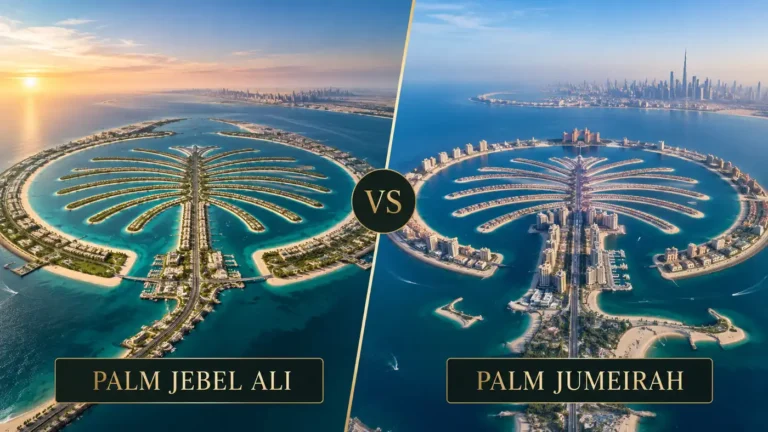
Deliveries are not spread evenly. The heaviest 2026–2027 completion clusters sit in Business Bay, Jumeirah Village Circle, Dubai South, Dubai Science Park, and Dubai Hills Estate, which together account for more than one-third of projected near-term handovers. Waterfront and master-planned launches, including Palm Jebel Ali and Dubai Islands, carry meaningful 2027 handover milestones as well.
For investors, the mapping is what matters: high-supply corridors face slower rent and price growth, while land-constrained communities are positioned to hold firm. The Dubai Pulse data portal allows buyers to track handover volumes in specific target areas before committing.
Dubai Property Forecast 2027: Price and Rent Projections
With supply framed, the pricing question becomes tractable. The 2027 Dubai property market outlook points to a fragmented market rather than a single trend line.
Capital Appreciation Outlook
Institutional forecasts for 2026 clustered in a narrow band, and that discipline carries into 2027. ValuStrat projected citywide capital value growth near 10% for 2026, with villas expected to outperform by appreciating close to 17.7%. Knight Frank took a more conservative stance, forecasting prime growth near 3% and mainstream growth near 1%. Across analysts, most institutional views for the near term fall in the 3% to 6% range, with an optimistic ceiling around 8% and a downside scenario of roughly -5%.
The risk case is credible but bounded. Fitch Ratings has flagged a potential adjustment of up to 15% in a scenario where supply meaningfully outpaces population growth. That correction is a possibility to plan for, not a base case, and it would likely concentrate in oversupplied, speculative sub-markets rather than land-scarce prime districts.
Elias Hannoush, Managing Director at Morgan's, framed the coming period as a moment of "reckoning" in which data, not sentiment, should guide decisions. Faisal Durrani, Head of Middle East Research at Knight Frank, has argued that Dubai's established prime districts are evolving into global "trophy addresses" that demonstrate resilience even during broader adjustments.
Rental Yields and the Rental Market
Rents were forecast to stabilize as the largest delivery wave in a decade reached the market. ValuStrat expected residential rental growth to flatten toward 0% as rates approached market ceilings in heavily supplied areas. That cooling is not uniform. Prime villas and land-constrained communities are expected to hold or gently increase rents, supported by limited availability and sustained high-net-worth interest.
There is a silver lining for income investors. Where sales-price growth softens while rents hold, gross yields can be preserved or even improve. Mid-market apartments in high-liquidity communities offer cash-flow in 2027, a theme explored further in the best high-yield communities analysis.
Is Dubai Real Estate Crashing in 2027?
No. The evidence does not support a crash scenario, and framing 2027 as a collapse misreads the market's structure. A crash requires forced selling, high leverage, and a demand vacuum. Dubai enters 2027 with the opposite conditions: controlled mortgage leverage, an expanding resident base, and demand that has repeatedly absorbed supply that many commentators expected to overwhelm the market.
Several factors argue against a broad correction:
- Actual handovers consistently trail scheduled volumes, softening the supply shock in real time.
- Population growth adds absorptive capacity as new residents arrive daily and require housing.
- Regulation limits speculation through escrow protections and unit-level rent benchmarking.
- The market is segmented, so any weakness is likely to be localized rather than citywide.
The honest counterpoint is that specific sub-markets carry real downside. Corridors saturated with similar off-plan launches, thin end-user demand, and weak connectivity are exposed to price and rent softening regardless of the citywide trend. The distinction between a market crash and a segmented correction is the single most important idea in the 2027 outlook.
Economic Drivers Underpinning the 2027 Outlook
Dubai property predictions for 2027 rest on macroeconomic foundations that are unusually favorable relative to global peers.
Population Growth and Migration
Dubai's population reached roughly 4.1 million in 2026, having doubled since 2011, with net additions of several hundred new residents per day. The Dubai 2040 Urban Master Plan targets a population of 5.8 million, and continued inbound migration is the primary force absorbing new housing stock. More residents translate directly into more tenants and buyers, which is why demographic momentum sits at the center of every credible forecast.
Golden Visa, HNWIs, and Foreign Direct Investment
Wealth migration reinforces the demographic story. DUbai is now home to 81,200 millionaires, including 237 centi-millionaires, people with investable wealth exceeding $100 million, and 20 billionaires, according to the Henley & Partners World's Wealthiest Cities Report 2025. The emirate also led the world with 500 home sales above USD 10 million in 2025. The Golden Visa program, which grants long-term residency to qualifying property investors, continues to anchor this inflow, a mechanism detailed in the Golden Visa property investment guide.
D33, Infrastructure, and the AED-USD Peg
The Dubai Economic Agenda D33 targets doubling the economy by 2033 and lifting annual foreign direct investment from AED 32 billion toward AED 60 billion. Emirates NBD projected GDP growth of about 4.5% for 2026, outpacing the global average. Two additional pillars support investor confidence:
- Infrastructure delivery, including the expansion of Al Maktoum International Airport and the growth corridor linking Expo City to Dubai South and Palm Jebel Ali.
- Currency stability, as the AED has been pegged to the US dollar since 1997, removing exchange-rate risk for dollar-denominated investors.
Best Areas to Invest in Dubai for 2027
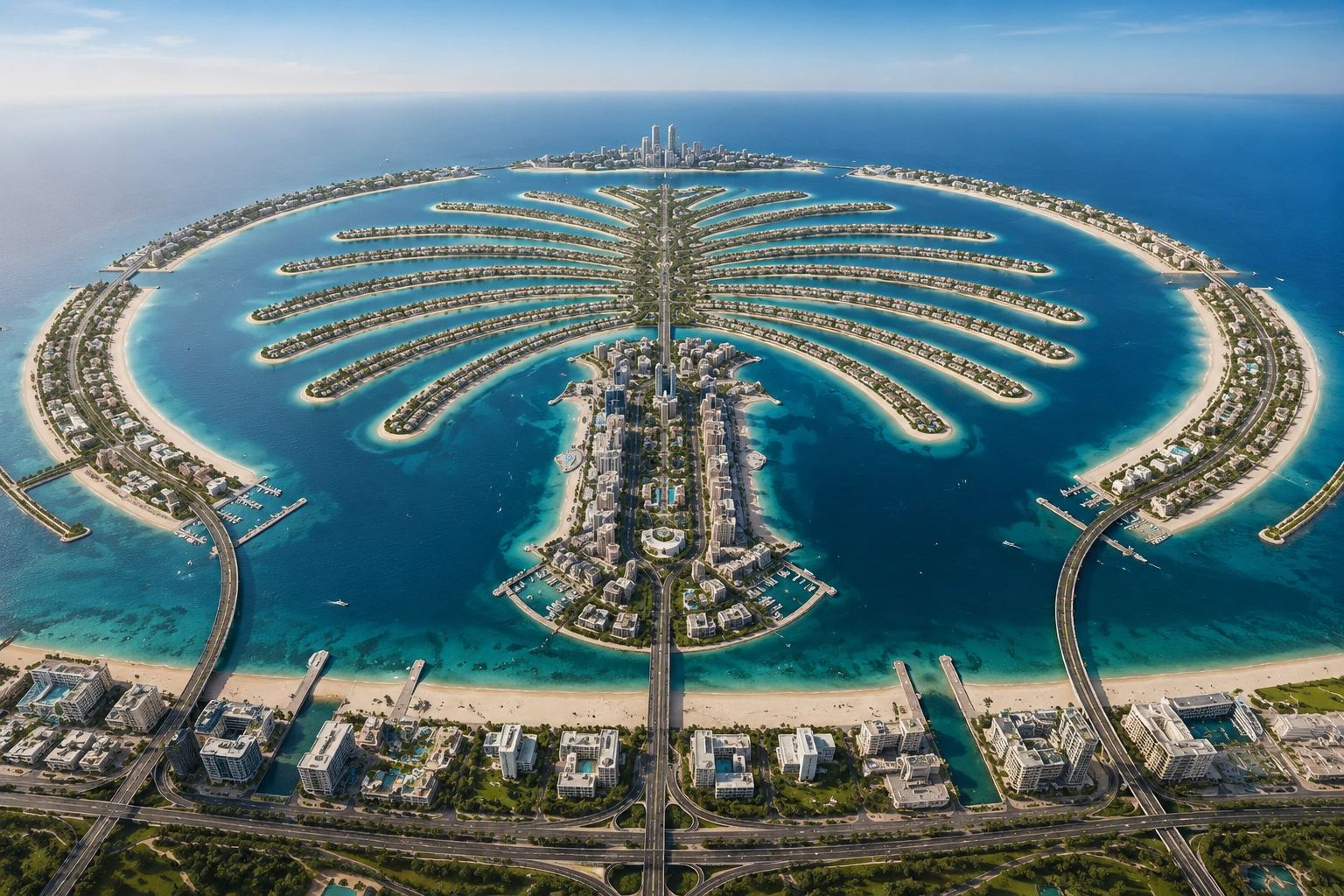
The strongest 2027 opportunities align with a simple rule: favor scarcity and connectivity, and treat heavy-supply corridors with caution.
Prime and Waterfront
Land-constrained waterfront addresses are positioned for resilience. Palm Jebel Ali, developed by Nakheel, is explicitly tied to the Dubai 2040 plan and D33, with early phases carrying 2027 handover milestones. Dubai Creek Harbour and Dubai Islands offer comparable waterfront scarcity. These districts suit buyers prioritizing long-term capital appreciation over immediate yield.
Mid-Market and High-Yield
For income-focused investors, mid-market apartments remain compelling. JVC combines the highest transaction volume in the city with gross yields near 7%, while Dubai South benefits from proximity to the new airport and long-term infrastructure. Business Bay led apartment price growth in 2026 and retains structurally elevated rental demand, though its heavier supply load warrants closer due diligence on specific towers.
Family Villa Communities
Dubai Hills Estate anchors the family-villa segment, offering strong schools, green space, and stable end-user demand. Villa communities more broadly are expected to outperform apartments on capital appreciation, supported by limited land and durable lifestyle demand.
| Area | Best suited for | 2027 positioning |
|---|---|---|
| Palm Jebel Ali | Capital appreciation | Waterfront scarcity, phased 2027 handovers |
| Dubai Creek Harbour | Growth and lifestyle | Master-planned, prime pipeline |
| JVC | Rental yield | High liquidity, ~7% gross yield |
| Dubai South | Long-term growth | Airport-adjacent, infrastructure-led |
| Dubai Hills Estate | Family end-users | Stable appreciation, limited land |
Off-Plan vs. Secondary Market in 2027
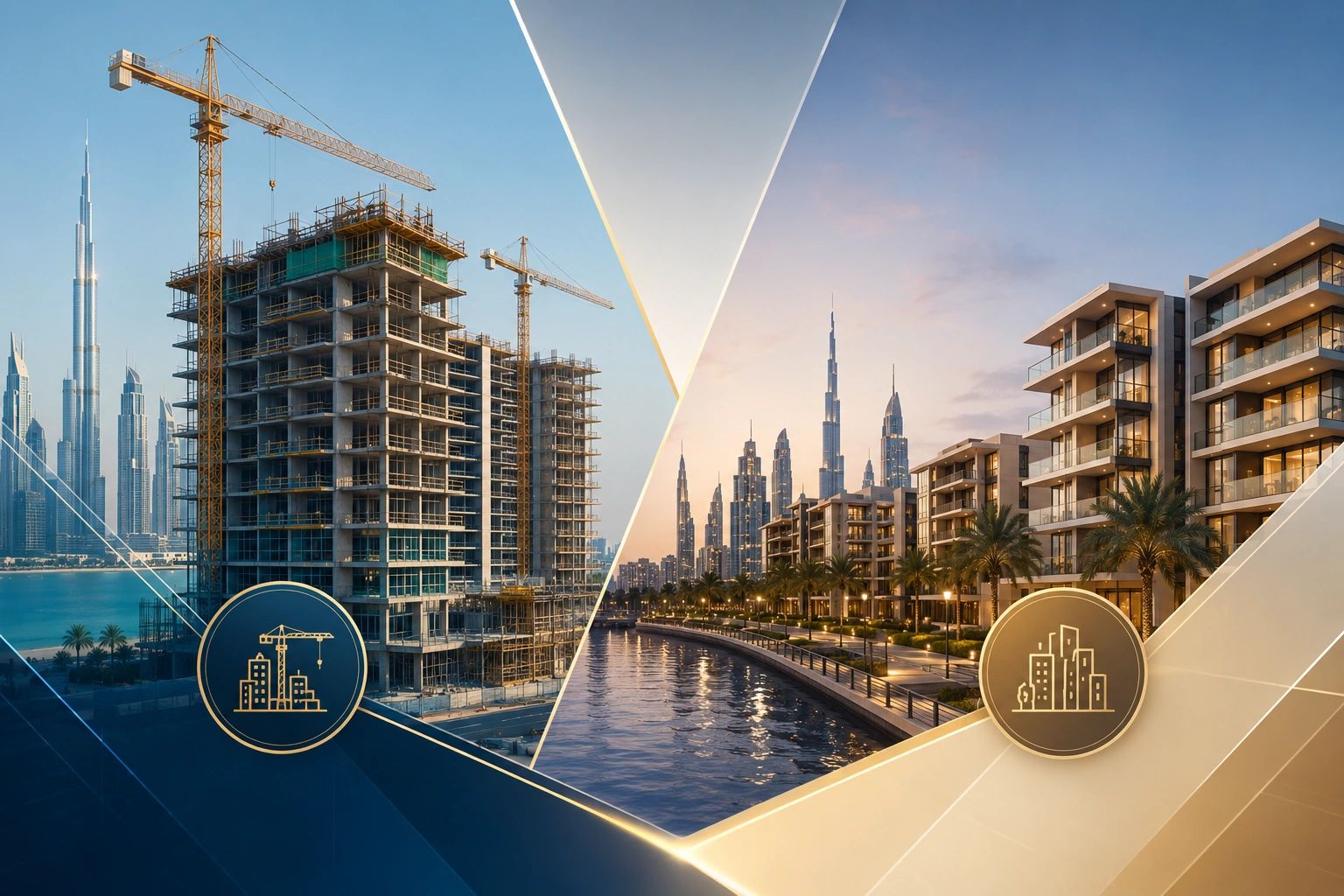
The off-plan versus secondary decision defines risk and return in a high-delivery year. Off-plan properties in Dubai for 2027 offer lower entry prices, typically 15% to 25% below equivalent ready stock, alongside flexible payment structures. Post-handover payment plans allow buyers to spread a portion of the price over years after completion, easing cash-flow pressure.
The trade-offs are equally clear:
- Off-plan advantages: lower entry cost, staged payments, modern specifications, and early-phase appreciation potential in strong master communities.
- Off-plan risks: completion delays, exposure to the 2027 supply wave at handover, and dependence on developer delivery records.
- Secondary market advantages: immediate rental income, verified build quality, and no completion risk.
- Secondary market risks: higher entry price and, in some buildings, rising service charges that erode net yield.
Every off-plan purchase in Dubai must register through the Oqood system and route buyer funds into a project escrow account, a safeguard examined in the off-plan buyer protection guide.
Regulatory Framework: DLD, RERA, and Buyer Protection
Regulation is a core reason the 2027 outlook favors stability over volatility. The Dubai Land Department and its regulatory arm, RERA, enforce a framework designed to protect capital and curb speculation.
Key protections include:
- Escrow accounts, which ring-fence off-plan buyer payments and release funds to developers only as construction milestones are verified.
- Oqood registration, which formally records off-plan contracts with the DLD.
- The Smart Rental Index, introduced by the DLD in 2026, which moved rent regulation from community averages to unit-level benchmarks using live Ejari data, adding transparency for landlords and tenants alike.
These mechanisms reduce the probability of the disorderly conditions that precede a crash and reinforce the case for a segmented, orderly market in 2027.
Conclusion
The Dubai real estate market forecast 2027 is best understood as a story of divergence rather than direction. A decade-high delivery year will test the market, but disciplined supply absorption, robust population growth, and a mature regulatory framework argue strongly against a crash. Prime and land-constrained communities are positioned to hold or grow value, high-yield mid-market apartments should preserve income, and oversupplied corridors carry the real risk. For investors, the winning strategy in 2027 is selectivity: prioritize scarcity, connectivity, and developer quality, and verify every assumption against official DLD data.
Investors evaluating specific communities for 2027 should begin with a personalized area assessment. Explore the 2027 investment area shortlist or request a tailored consultation to align portfolio goals with the districts most likely to outperform.
Frequently Asked Questions
Will Dubai property prices fall when new 2027 supply hits?
Prices are unlikely to fall across the board. Most analysts expect selective softening in oversupplied corridors while land-constrained and prime communities hold firm. Actual handovers routinely trail scheduled volumes, and continued population growth adds absorptive capacity, which together limit the risk of a citywide decline.
How many residential units will actually be handed over in Dubai in 2027?
Scheduled 2027 supply sits near 146,400 units, but real delivery is expected to be substantially lower due to routine slippage. One supply study estimates roughly 70,500 units genuinely delivered in 2027, which would still be about 98% above the five-year average and the highest single-year total in over a decade.
Are mid-market apartments in Dubai a good investment for 2027?
Mid-market apartments in high-liquidity communities such as JVC and Dubai South remain a strong income play, offering gross yields near 6% to 8.5%. They suit investors prioritizing cash flow, provided the specific building is not sitting in a heavily oversupplied cluster with many identical units completing at once.
What are the best off-plan villa projects in Dubai for 2027 delivery?
Waterfront and master-planned villa communities with phased 2027 handovers, including Palm Jebel Ali, Dubai Islands, and Dubai Creek Harbour, are among the most compelling for capital appreciation. Buyers should prioritize developer track record and confirm handover timelines through official DLD and Dubai Pulse channels.
How will Dubai's population growth affect 2027 real estate prices?
Population growth is the primary force absorbing new supply. With the resident base near 4.1 million in 2026 and a 2040 target of 5.8 million, sustained inbound migration supports both rental demand and end-user purchases, cushioning the market against the record delivery pipeline.
Is Dubai real estate crashing in 2027?
No credible base case points to a crash. The market is regulated, end-user driven, and supported by strong demographics and controlled leverage. Any weakness is expected to be localized in speculative, high-supply sub-markets rather than a broad market collapse.