Table of Contents
Dubai Real Estate Market Report 2026: Why Did Off-Plan Sales Hit a Record AED 73.4 Billion in Q1?
Dubai’s real estate market just shattered its own record — and off-plan properties are leading the charge. Here is everything investors, buyers, and expats need to know about Q1 2026’s landmark performance.
Q1 2026 at a Glance: The Numbers That Matter
Before diving into the “why,” it helps to understand the scale of what happened in the first quarter of 2026:
Metric | Q1 2026 Figure |
|---|---|
Total market transaction value | AED 176.7 billion |
Total transactions | ~47,996 deals |
Off-plan sales value | AED 73.4 billion (record high) |
Highest single-month sales ever | AED 72.4 billion (January 2026) |
Off-plan share of transactions | ~70% |
These are not incremental gains — they represent a fundamental shift in how Dubai property is being bought and by whom. So what is actually driving this surge?
Why did off-plan sales in Dubai hit a record in Q1 2026?
Dubai’s off-plan sales reached a record AED 73.4 billion in Q1 2026 due to a surge in major developer launches, flexible payment plans lowering entry barriers, growing international investor confidence, UAE Golden Visa incentives for property buyers, and a rapidly expanding professional resident base choosing ownership over renting.
What Drove the AED 73.4 Billion Off-Plan Record?
1. A Wave of Major Developer Launches
Late 2025 and early 2026 saw an unprecedented number of large-scale project launches from Dubai’s leading developers. High-profile launches across Dubai Marina, Downtown, Dubai Creek Harbour, and Jumeirah Village Circle created a pipeline of inventory that buyers moved quickly to absorb. Many of these launches sold out within days — or even hours — pushing transaction volumes to record highs before the end of January alone.
The launch cycle has become self-reinforcing: strong absorption rates encourage developers to accelerate new releases, which in turn generate even greater transaction volume. This is a market running on genuine demand.
2. Flexible Payment Plans Are Lowering the Entry Barrier
One of the most powerful drivers of off-plan demand is the evolution of developer payment plans. Structures such as 10/40/50 (10% on booking, 40% during construction, 50% on handover) and 1% per month post-handover plans have made off-plan properties significantly more accessible than ready units requiring full mortgage financing upfront.
For a buyer looking at an AED 1.5 million apartment, a 10% booking payment of AED 150,000 is a far more manageable entry point than a 20–25% mortgage down payment on a secondary market property. Use our mortgage calculator to compare monthly costs across both options. This affordability structure is a long-term tailwind for off-plan demand — not a short-term trend.
How do off-plan payment plans work in Dubai?
Dubai off-plan payment plans allow buyers to purchase directly from developers with staged payments. A common structure is 10% on booking, 40% during construction, and 50% on handover. Some developers offer 1% monthly post-handover plans. This makes entry far more accessible than a full mortgage down payment on a ready property.
3. Shifting Buyer Profiles: Who Is Actually Buying?
The Q1 2026 surge is not being driven by a single buyer type. Three distinct groups are converging on the off-plan market simultaneously:
- International investors from Europe, Asia, and the wider MENA region, drawn by Dubai’s zero capital gains tax, strong rental yields of 5–8% in key communities, and currency stability
- GCC residents and nationals increasingly viewing Dubai as a second home or primary investment hub amid strong regional economic growth
- End-users and expats already living in Dubai, many transitioning from renting to owning for the first time, supported by long-term residency confidence following the UAE’s visa reforms
The investor-versus-end-user split has tightened meaningfully. More genuine owner-occupier demand is underpinning the market — a clear sign of structural depth and sustainable growth rather than purely speculative activity.
4. UAE Policy Tailwinds: Visas, Residency, and Reform
The UAE’s policy environment has materially shifted the calculus for long-term property ownership. Key drivers include:
- Golden Visa expansion: Property buyers investing AED 2 million or more can qualify for a 10-year residency visa, directly incentivising purchases at premium price points
- Remote work and freelance visa schemes: Attracting a younger, globally mobile professional class seeking a stable regional base
- Strong tourism recovery and airlift growth: Reinforcing Dubai’s position as a global hub, supporting both short-term rental demand and long-term investor confidence
- Regulatory clarity: RERA oversight and escrow protections for off-plan projects have materially improved buyer confidence, making the market one of the most transparent and well-regulated in the region
Can buying property in Dubai give you a residency visa?
Yes. Dubai’s Golden Visa programme grants a 10-year UAE residency visa to property buyers who invest AED 2 million or more. The visa is renewable and covers immediate family members. It has been a major driver of long-term property demand from international and MENA-region investors since its expansion in recent years.
Dubai Off-Plan Property Trends 2026: Key Areas to Watch
Top Communities Driving Off-Plan Demand
The communities consistently recording the highest off-plan transaction volumes in Q1 2026 include:
- Dubai Creek Harbour — Master-planned waterfront community with a strong developer pipeline from Emaar and compelling long-term capital appreciation
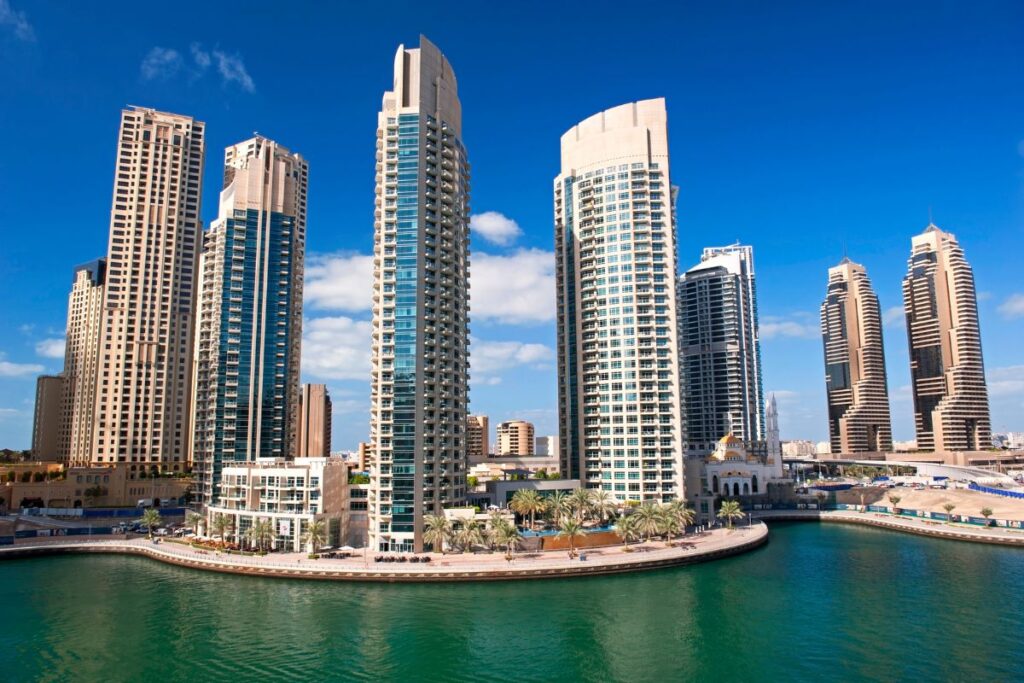
- Dubai Marina and JBR — Premium branded residences driving high average ticket sizes and strong international buyer depth
- Jumeirah Village Circle (JVC) — Dominant in unit volume due to accessible price points and consistently strong rental yields
- Mohammed Bin Rashid City (MBR City) — Luxury villa communities with significant GCC and international buyer interest
- Business Bay — Central location and improving infrastructure supporting both investor and end-user demand
- Dubai South / Expo City — One of the lowest-risk, highest-potential opportunities in the market right now, backed by world-class infrastructure, the Al Maktoum International Airport expansion, and a long-term government master plan that continues to deliver on its promises
Explore all communities to see active off-plan listings across each of these areas.
Is Dubai South a good place to invest in 2026?
Dubai South is considered one of the lowest-risk investment areas in Dubai in 2026. Backed by a strong government master plan, the ongoing Al Maktoum International Airport expansion, Expo City infrastructure, and steady demand from professionals working in the area, it offers solid rental yields and long-term capital growth potential at accessible entry prices.
Price Per Square Foot Trends in Q1 2026
Average price-per-sqft figures have continued their upward trajectory across key segments:
- Apartments (citywide average): AED 1,400–1,800/sqft for mid-market; AED 3,000+ for ultra-luxury branded residences
- Villas: Strong price appreciation in Palm Jumeirah, Arabian Ranches, and Damac Hills, with off-plan villa launches frequently priced above AED 2,500/sqft in premium locations
- Year-on-year appreciation: Select communities have recorded 15–25% YoY price growth, with branded luxury product outperforming the broader market
Q1 2026: Secondary Market vs Off-Plan
The secondary (ready) market has not stood still either. AED 103.3 billion of the Q1 total represents ready property transactions — demonstrating that demand for immediately available units remains robust. However, the off-plan advantage of locking in today’s price on a property that won’t deliver for 2–4 years continues to make it the preferred vehicle for capital appreciation strategies.
Off-Plan | Secondary Market | |
|---|---|---|
Entry cost | Lower (flexible payment plans) | Higher (mortgage or full cash) |
Capital appreciation potential | Higher (buy at launch price) | Moderate (priced to market) |
Rental income | Upon handover | Immediate |
Risk profile | Well-regulated with RERA escrow protection | Lower completion risk |
Best for | Investors with 3–5 year horizon | End-users and income-seekers |
For common questions about off-plan buying in the UAE, visit our FAQ page.
What is the difference between off-plan and secondary market property in Dubai?
Off-plan properties are purchased directly from developers before or during construction, typically with staged payment plans and strong capital appreciation potential. Secondary market properties are existing, ready-to-occupy units sold by owners, offering immediate rental income. Off-plan suits investors with a 3–5 year horizon; secondary market suits buyers seeking immediate returns or occupancy.
Best Areas to Invest in Dubai 2026: Where Is the Smart Money Going?
For investors evaluating where to deploy capital in 2026, three broad strategies are delivering results:
High-Growth Waterfront — Premium Capital Appreciation
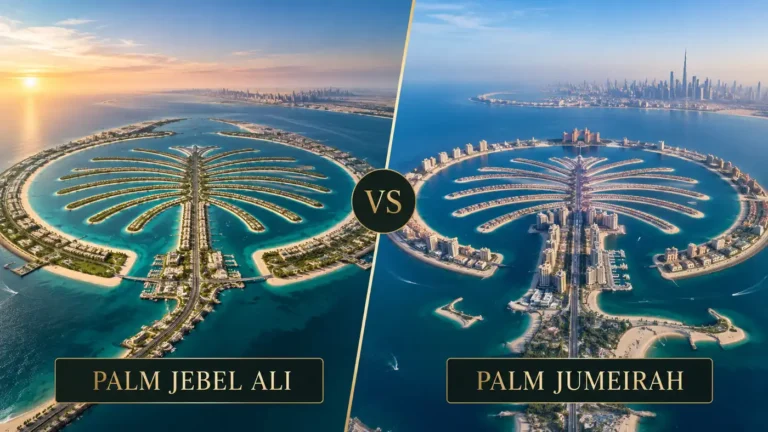
Dubai Creek Harbour, Dubai Harbour, and Palm Jebel Ali offer waterfront positioning with significant long-term master-plan upside. These are premium-entry markets with strong brand recognition and deep international buyer pools that continue to drive price performance.
Mid-Market Yield Play — Rental Income Focus
JVC, Arjan, Dubai Silicon Oasis, and Dubai South offer attractive gross yields — often in the 7–9% range — at accessible price points. These communities benefit from Dubai’s fast-growing salaried professional tenant base and government-backed infrastructure investment. Dubai South in particular stands out for its combination of low entry price, strong yield, and long-term growth fundamentals tied to one of the world’s largest airport expansion projects.
Lifestyle and Branded Luxury — Trophy Asset
Downtown Dubai, Business Bay, and Palm Jumeirah continue to attract ultra-high-net-worth buyers seeking globally recognised addresses. Branded residences from Bugatti, Lamborghini, and major international hotel operators are driving premium pricing and setting new benchmarks in this segment.
Ready to explore options across all three strategies? View off-plan projects in Dubai, Abu Dhabi, RAK, and beyond.
Which areas in Dubai offer the best rental yields in 2026?
Dubai South, Jumeirah Village Circle (JVC), Arjan, and Dubai Silicon Oasis consistently offer the strongest gross rental yields in 2026, typically ranging from 7–9%. These communities benefit from high tenant demand, affordable entry prices, and strong infrastructure investment, making them top choices for investors focused on rental income over capital appreciation.
H2 2026 Outlook: What to Expect
The Dubai market enters the second half of 2026 with strong fundamentals across all key segments. Market analysts point to a well-supported base case:
Scenario | Key Assumption | Price Trajectory |
|---|---|---|
Base case | Steady demand, well-managed supply pipeline | +5–10% YoY in prime segments |
Upside case | Continued policy tailwinds, strong global investor appetite | +15–20% in select communities |
Strong growth case | Waterfront and branded luxury demand accelerates | Record pricing in premium segments |
Dubai’s position as a global hub — with zero capital gains tax, a stable currency, expanding infrastructure, and a government committed to long-term vision — makes the market uniquely resilient and attractive for investors at every entry point.
What is the Dubai real estate market forecast for H2 2026? Dubai’s real estate market H2 2026 forecast is positive. The base case projects 5–10% year-on-year price appreciation in prime segments, with waterfront and branded luxury communities expected to outperform. Strong international investor demand, government policy support, UAE Golden Visa incentives, and infrastructure expansion underpin continued market growth through the remainder of 2026.
Frequently Asked Questions
Why did off-plan sales in Dubai spike in Q1 2026?
The spike reflects the convergence of several factors: a high volume of new developer launches, flexible payment plan structures that lower entry barriers, growing international investor interest driven by tax advantages and residency visa incentives, and strong underlying demand from Dubai’s expanding professional resident population.
Which developers recorded the highest off-plan sales in 2026?
Emaar Properties, Damac, Sobha Realty, Nakheel, and Aldar (expanding its Dubai footprint from Abu Dhabi) have been among the most active. Browse projects by developer to explore active listings and current availability from each of the market’s leading names.
Is now a good time to buy off-plan property in Dubai?
For investors with a 3–5 year horizon, off-plan continues to offer the strongest capital appreciation potential — particularly in well-located communities from established developers. For those seeking immediate rental income, the secondary market may better suit near-term objectives. Engaging a RERA-registered broker to assess your specific situation is always advisable.
How does off-plan differ from the secondary market in Dubai?
Off-plan properties are purchased directly from developers before or during construction, typically with flexible staged payment plans. Secondary market properties are existing, ready-to-occupy units sold by owners. Off-plan offers lower entry costs and potential price appreciation between launch and handover; secondary market offers immediate occupancy and rental income.
What buyer protections exist for off-plan purchases in Dubai?
RERA’s escrow account regulations require developers to hold buyer funds in protected accounts that can only be drawn upon as construction milestones are met. This framework, combined with the Dubai Land Department’s regulatory oversight, provides a robust layer of protection that makes Dubai one of the most buyer-friendly off-plan markets in the world.
How did Dubai’s 2025 policy changes affect real estate demand?
The expanded Golden Visa programme, new freelancer and remote work visa categories, and continued improvements to RERA’s regulatory framework all deepened buyer confidence and attracted new buyer segments — particularly long-term international residents who previously rented and are now choosing ownership with a long-term vision.
Ready to Explore Dubai’s Off-Plan Market?
The AED 73.4 billion Q1 2026 off-plan record is not just a statistic — it is a signal that Dubai’s property market has entered a new phase of maturity, depth, and global relevance. Whether you are a first-time buyer exploring your options or a seasoned investor looking to expand your UAE portfolio, having the right guidance makes all the difference.
First Stone Real Estate specialises exclusively in off-plan properties across the UAE. Our team of RERA-registered consultants can help you navigate project selection, payment plan structures, developer due diligence, and long-term investment strategy — with no pressure, just clarity.
Get in touch with First Stone Real Estate today to discuss which Q1 2026 opportunities still represent strong value, and how to position your portfolio for H2 2026 and beyond.
Data sources: Dubai Land Department (DLD), Property Finder Market Intelligence, Engel & Völkers Dubai Residential Report Q1 2026, PS Investments Market Research. All figures quoted refer to Q1 2026 unless otherwise stated. Market data is subject to revision as official DLD figures are finalised.
Published: May 2026 | First Stone Real Estate — firststonerealestate.com
Dubai Property Investment 2026: Where Smart Money Is Moving Right Now
The market has softened. Supply is hitting the city. Some buyers have stepped back.
Which means one thing for a prepared investor: the window is open.
Corrections do not destroy good assets. They reprice them. And in Dubai right now, assets that were untouchable at 2022–2023 prices are sitting at 8–15% discounts, with sellers motivated and developers offering the most flexible payment plans in four years.
This guide is not about whether to invest. It is about where, what, and how — so you move with the data, not against it.
5.9%Price adjustment (ValuStrat, March 2026) | 6–8%Gross rental yields still achievable | 65%Off-plan share of all Dubai transactions | 2027Expected market stabilisation window |
Is 2026 a good time to buy property in Dubai?For investors with a clear strategy, 2026 is one of the most favourable entry windows since 2020. Price softening of 5–15% has emerged in key segments, sellers are negotiating, and payment plans are at their most flexible in four years. Gross rental yields of 6–8% remain achievable in well-selected communities with genuine occupier demand. |
The Real Picture: What the Data Actually Shows
Let’s put the headlines in context.
In March 2026, ValuStrat recorded a 5.9% price adjustment in Dubai’s residential market — the first meaningful movement since the pandemic. Fitch has flagged a possible 10–15% correction from peak values across the broader market. Moody’s describes the outlook as stable with modest softening.
Here is what experienced investors hear in that data: an extraordinary four-year run is normalising. Dubai’s residential stock of 700,000–750,000 units is absorbing 150,000–210,000 new homes between 2025 and 2027. That creates pricing pressure in specific oversupplied communities — and it creates buying opportunities in everything else.
Dubai has been through this before. The 2015–2016 oil-driven correction, the 2020 COVID shock — both were followed by stronger, more sustained growth cycles. The question is never if the market recovers. It is whether you positioned yourself before it did.
★ The Opportunity Window Sellers in key communities are accepting offers 8–12% below peak ask. Developers are extending payment plan timelines. Competition from other buyers is at a four-year low. This combination — motivated sellers, flexible terms, low competition — does not last long once confidence returns. |
What is causing the Dubai property market correction in 2026?Two forces are converging: a large supply wave of 150,000–210,000 new homes delivering between 2025 and 2027, and a temporary softening in investor confidence following early 2026 geopolitical developments. Both are cyclical, not structural. Well-located communities with genuine end-user demand are absorbing supply effectively and showing far smaller price adjustments. |
The Investor’s Map: Where to Move and Where to Wait
Dubai is not one market. It is a collection of micro-markets — each with its own supply pipeline, buyer mix, and yield profile. Knowing which to enter, and which to avoid in 2026, is the difference between a strong return and a poor one.
Palm Jumeirah & Ultra-Prime — Enter and Hold
Cash-based, HNWI buyers dominate this segment. Supply is structurally limited. Branded residences from Lamborghini, Mercedes, and Bugatti have created a product class with its own global buyer pool. Price corrections here are minimal. These are assets you accumulate in any market cycle.
✔ Investor Verdict: Transact now. This segment does not discount. Any available unit at current prices is a long-term hold. |
Downtown Dubai & MBR City — Negotiate Hard
Moderate supply entering a market with strong occupier demand. End-users and long-term investors both active. This is where buyers with prepared financing and clear timelines are extracting 8–12% off peak prices from motivated sellers. That margin turns into equity from day one.
✔ Investor Verdict: Make offers 10% below ask. Sellers are moving. Tier-1 off-plan in MBR City from Emaar is particularly well-protected. |
Dubai South — The Structural Growth Story
Dubai South is not a speculative bet. It is a government-backed, master-planned city built around Al Maktoum International Airport — which, when fully operational, will be the world’s largest. Expo City, the logistics hub, and DWC expansion are all driving genuine end-user and corporate occupier demand.
Supply here is well-planned and absorbed by real population growth. Rental demand is expanding rapidly. Infrastructure is being delivered on schedule. This is one of the lowest-risk entry points in the Dubai market right now, with one of the strongest long-term growth profiles.
✔ Investor Verdict: Strong entry point. Well-planned supply, growing end-user base, long-term airport and logistics tailwinds. Buy on fundamentals. |
Dubai Marina & JBR — Short-Term Rental Play
Tourism demand remains robust. Gross STR yields of 7–9% are still achievable for well-managed units. The correction here is modest. The key is operator quality and realistic daily rate assumptions — model 10% softer than 2024 actuals and the numbers still work.
✔ Investor Verdict: Viable for STR-focused investors. Be conservative on yield assumptions. Choose buildings with strong management and low service charges. |
Business Bay — Patient Capital Only
High investor concentration and significant incoming supply mean pricing power sits firmly with buyers. If you are entering here, enter at a deep discount, with a longer hold horizon. Not the right market for investors seeking quick liquidity.
✔ Investor Verdict: Only for patient capital at the right price. Negotiate hard and plan for a 3–5 year hold before exit. |
JVC — Sit This One Out
Very high investor-to-end-user ratios combined with one of the largest incoming supply pipelines in the city. The math on exits is genuinely difficult right now. Monitor for 12–18 months.
✔ Investor Verdict: Wait. The supply picture needs to clear before this becomes a confident entry point. |
Which areas in Dubai offer the best investment opportunity in 2026?Palm Jumeirah, Downtown Dubai, Dubai South, and MBR City offer the strongest investment conditions in 2026. Palm Jumeirah benefits from limited supply and ultra-prime demand. Downtown and MBR City allow motivated-seller negotiation. Dubai South offers a rare combination of government-backed infrastructure, growing end-user demand, and long-term airport expansion upside. |
Community Opportunity Ratings: 2026
Each community below is rated on supply exposure, buyer mix, rental demand, and — most importantly for an investor — the current opportunity signal.
Area | Supply | Buyer Mix | Rental | Investor Opportunity Signal |
Palm Jumeirah | Low | 70%+ HNWI | Strong | 🟢 Prime — Hold & appreciate |
Downtown Dubai | Moderate | Mixed | Strong | 🟢 Negotiate 8–12% off ask |
Dubai South | Well-planned | End-user & investor | Growing rapidly | 🟢 Strong long-term entry |
Jumeirah Islands | Low | End-user dominated | Villa demand | 🟢 Stable, low competition |
MBR City | Moderate | Mixed | Growing | 🟡 Selective — Tier-1 only |
Dubai Marina | Moderate | High investor | Strong (STR) | 🟡 STR plays still viable |
Business Bay | High | Predominantly inv. | Moderate | 🟠 Price carefully, be patient |
JVC | High | Very high investor | Moderate | 🔴 Wait — oversupply risk |
Individual projects within each area may differ. Tier-1 developer projects consistently outperform community averages.
Is Dubai South property a good investment in 2026?Yes. Dubai South is one of the strongest investment areas in 2026. Backed by government planning, proximity to Al Maktoum International Airport, and rapidly growing rental demand from Expo City and logistics occupiers, it combines low correction risk with strong long-term growth potential. Unlike outer speculative communities, Dubai South has real infrastructure and real end-user demand. |
Off-Plan in 2026: The Right Way to Play It
Off-plan represented 65% of all Dubai transactions in 2025. That dominance has not collapsed — but it has bifurcated. The difference between a Tier-1 off-plan project and a smaller developer’s launch is wider today than at any point in the last five years.
Tier-1 Developers: Emaar, Nakheel, Meraas
Government-backed or institutionally anchored. Strong delivery track records. Escrow compliance is embedded. Resale secondary markets are liquid. Post-handover payment plans extend your runway significantly. Buying off-plan from Emaar in 2026 with a 60:40 payment plan means you are accessing today’s discounted prices while deferring the majority of your capital outlay into a recovering market.
★ The Payment Plan Advantage Today’s Tier-1 off-plan payment plans are structured to let you pay 40–50% during construction and the remainder on or after handover. If the market recovers 10–15% by 2027–2028 as analysts project, you will have captured that upside while having paid a fraction of the total price. This is leverage without a mortgage. |
Smaller Developers: Proceed With a Checklist
Some smaller developers are building excellent product. Others are financially stressed by slower sales velocity and rising construction costs. The gap between the two is not always visible in the marketing material. Before committing:
- Verify RERA registration and confirm escrow account compliance
- Check the developer’s delivery record — have previous projects completed on time and to specification?
- Review their current sales velocity — low velocity in a softening market increases delivery risk
- Understand your refund and exit protections before signing anything
Is off-plan property a good investment in Dubai in 2026?Off-plan from Tier-1 developers remains a strong investment in 2026. Discounted launch prices, flexible post-handover payment plans, and escrow protection make it a compelling entry point. The key is developer selection — Emaar, Nakheel, and Meraas projects carry significantly lower risk than smaller developers operating in oversupplied locations. |
The Yield Investor’s Playbook
Rental yields in Dubai remain among the most competitive of any major global city. The correction has not destroyed yield — in some communities it has improved it, as lower entry prices produce better yield on cost.
6–8% Gross yield — well-chosen mid-market | 7–9% Gross yield — quality STR in Marina/JBR | 5–6% Gross yield — prime Downtown/Palm | 0% Income tax on rental income |
Conclusion
The correction is priced in. The fundamentals are intact. And the investors who move in 2026 — not when the all-clear sounds, but right now while sellers are motivated and competition is low — are the ones who will look back at this as their best entry point in four years.
Dubai’s structural story has not changed. Zero income tax. Freehold ownership for foreigners. A city adding population faster than almost anywhere else on the planet. Infrastructure being delivered on a scale few global cities can match. These are not talking points — they are the reasons capital keeps returning here after every cycle, every shock, every correction.
What has changed is the balance of power. In 2022, you competed for everything. In 2026, the market comes to you. Sellers negotiate. Developers extend payment plans. Units that were gone in hours are available at a considered price. That environment does not last. It closes the moment confidence returns — and the data suggests that window is 12 to 18 months wide at most.
The investors who will miss it are the ones waiting for perfect certainty. It never comes. What comes instead is a recovered market, higher prices, and the familiar feeling of having watched the opportunity from the sidelines.
Ready to move with the market, not behind it?
At First Stone Real Estate, we work exclusively in off-plan property across the UAE. We know which developers are delivering, which communities have real occupier demand, and which payment plans give you the best runway into a recovering market.
No noise. No speculation. Just the right asset, at the right price, structured for where the market is going.

Dubai InvestmentDubai Real Estate OpportunitiesOff-Plan PropertiesProperty Market 2026Rental Yield Dubai