

The Danube Deal of the Decade is a three days developer offer running across 37 Danube Properties towers in Dubai on 7,8 and 9 September 2026. Buyers pay 20% of the property value plus the 4% Dubai Land Department (DLD) registration fee, and 10% of the property value returns as a credit note. Whether you are a first-time buyer, a yield-focused investor, or an end-user upgrading from a rental, the structure changes what leaves your account upfront. This guide explains how the 10% credit note is applied, compares the 1% and 0.5% monthly tracks, and highlights the projects, fees and conditions worth checking before you commit to a unit. What Is the Danube Deal of the Decade? The Danube Deal of the Decade is a limited-window payment offer from Danube Properties, live on 7,8 and 9 September 2026 across 37 towers in Dubai. Buyers commit 20% of the property value plus the 4% DLD registration fee, and receive a credit note worth 10% of the property value against the outstanding balance. The 10% comes back as a rebate against what you still owe, not as cash in hand. A further 40% of the price is deferred past handover, so only 60% falls due before you hold the keys. According to the developer, participating inventory starts from AED 1.1 million, spread across studios and larger layouts in several communities. The promotion will be available at the Danube Properties office on Sheikh Zayed Road, opposite Times Square, Al Manara, Dubai, on both days. How the 20% Down Payment and 10% Rebate Work Danube Properties making home ownership easy with their Deal of the Decade offer. The 20% is collected in two tranches, and the DLD fee lands alongside the second one. Once both tranches and the fee clear, the monthly phase begins, and the balance falls due after completion. The payment sequence: 10% of the property value within 21 days A further 10% within 60 days 4% DLD registration fee with the second tranche 1% or 0.5% of the property value each month until completion 40% of the price deferred past handover The credit note enters the schedule at different points depending on the track you pick. On the 1% track, it is applied as soon as the 20% and the DLD fee are paid. On the 0.5% track, it is held back until your cumulative payments reach 40% plus the fee. Either way, this reduces your balance and shortens the tail of instalments. Dubai Land Department fees remain payable in full regardless of the rebate. The 1% and 0.5% Tracks Compared Both tracks open with an identical 20% commitment and defer an identical 40% past handover. The difference lies in the monthly figure and in when the rebate reaches your balance. Feature 1% Track 0.5% Track Down payment 20% + 4% DLD 20% + 4% DLD Monthly instalment 1% of property value 0.5% of property value Monthly on AED 1.5 million AED 15,000 AED 7,500 Rebate released After 20% + DLD fee After 40% + DLD fee Deferred to post-handover 40% 40% Figures vary by project, unit and the terms recorded in the signed sales and purchase agreement. The choice generally comes down to cash flow against timing. The 1% track suits buyers who want the 10% working against the balance immediately, while the 0.5% track suits buyers who prefer smaller monthly instalments and can wait for the credit. On an AED 1.5 million apartment, the gap is AED 7,500 a month. The 11:11 Lineup: Eleven Towers on a 20:70 Structure Danube 11:11 lineup applies a simpler 20:70 split, where the 10% credit note follows the 20% down payment and the remaining 70% falls due on completion instead of monthly. Confirmed names inside the lineup include Fashionz 1, Sparklz, Viewz 1, Viewz 2, Oceanz 1, Oceanz 2, Oceanz 3, Oasiz 1, Oasiz 2, Elitz 2, and Elitz 3. The 20:70 shape typically appeals to buyers planning a mortgage at handover or an exit before completion, because very little is paid during construction. Resale and assignment rules differ by project, so confirm them before booking. How the Rebates Stack: Token, Family and Full Payment The 10% credit note is the floor of the offer, not the ceiling. Three further mechanisms can be layered on top, each with its own condition attached. Where the extra percentages come from: Refundable token: A refundable AED 100,000 token adds another 1% of the property value, and applies to every participating project except Greenz. Family purchases: Immediate family buying together, such as a spouse, parent or child, earn an additional 2% to 4% depending on the combined value of the units. Full upfront payment: Paying the full price at once replaces the staged structure entirely with a flat 14% discount. Base credit note: The standard 10% applies to every qualifying unit, released per the track you select. Combined, these can move the total benefit well beyond the headline number, though each layer carries its own paperwork and approval step with the developer. Which Danube Projects Are Included? Danube Deal of the Decade projects. The Danube Deal of the Decade offer runs across 37 Danube towers spread through central and suburban Dubai. A handful of the headline projects show the range of locations and price points involved. Headline projects under the offer: Bayz 101: A tall residential tower in Business Bay, close to the Burj Khalifa, running on the main 1% and 0.5% tracks. Oceanz by Danube: A three-tower waterfront cluster in Dubai Maritime City, included across the 11:11 lineup. Viewz by Danube: Twin towers in JLT joined by a sky bridge, with both buildings in the 11:11 lineup. Fashionz by Danube: A JVT development on the 20:70 structure, with the rebate following the 20%. Sparklz by Danube: An Al Furjan tower on the 20:70 structure, with 70% falling due on completion. Danube units are typically delivered fully furnished and carry a deep amenity list, which is a large part of the appeal for tenants and short-stay
Dubai Real Estate Market Forecast 2027: What to Expect
The Dubai real estate market forecast 2027 hinges on a single tension: a record pipeline of new homes arriving into a market that has spent three years absorbing demand faster than developers could build. The short answer is that most institutional analysts expect selective, moderate growth rather than a crash, with performance splitting sharply by location, asset type, and developer track record. Prices are unlikely to rise uniformly, and they are unlikely to collapse. Instead, the emirate is entering a phase where fundamentals, not momentum, decide which communities hold value. Where the Dubai Market Stands Heading Into 2027 Any credible Dubai property forecast 2027 begins with the 2026 baseline, because that is the year the market shifted from broad expansion to measured selectivity. Transaction Activity and Pricing in 2026 Momentum remained strong through the first half of 2026, even as volumes cooled from the record levels of 2025. Dubai recorded roughly 79,000 residential sales worth approximately AED 221.4 billion in H1 2026, according to DLD data. For context, total DLD transaction value reached about AED 761 billion in 2024, a 20% increase over the prior year, per Betterhomes. Three structural features defined the 2026 baseline: End-user demand replaced speculation. Genuine occupier buying has risen materially since 2021, reducing the market’s reliance on short-term flipping. Villas outperformed apartments. Limited land and a preference for space kept house and townhouse pricing ahead of the apartment segment. Off-plan dominated activity. Off-plan purchases now account for roughly 60% to 65% of all Dubai transactions, reshaping how risk and payment timing are managed. Capital Appreciation and Rental Yields Today Pricing entered 2027 from an elevated but decelerating base. Knight Frank classifies Dubai as an “emerging” market rather than an emerging one, meaning it is regulated, end-user driven, and less prone to boom-bust swings. That maturity shows in the numbers: citywide values kept climbing in early 2026, but at a slower and more location-dependent pace than in 2022 or 2023. The table below summarizes representative 2026 pricing across core communities, drawn from DLD-linked transaction data. Community Avg. price per sq ft (2026) Investor profile Business Bay AED 2,547–2,673 High rental demand, apartment growth leader Dubai Marina AED 2,058 Established waterfront, strong liquidity Dubai Hills Estate AED 1,500–2,000 Family end-users, stable appreciation Jumeirah Village Circle (JVC) AED 1,500–1,600 High yield, highest transaction volume Citywide median AED 1,692–1,850 Blended apartment and villa benchmark Sources: DXB Analytics Rental yields remained a defining attraction. Affordable and mid-market communities such as JVC, Dubai South, and Motor City continued to deliver gross yields between 6% and 8.5%, while prime districts traded lower yields in exchange for stronger capital appreciation potential. The 2027 Supply Question: How Many Units Will Actually Be Handed Over? Supply is the pivot of every Dubai real estate prediction for 2027. The headline pipeline is enormous, but the gap between scheduled and delivered units is the number that actually moves prices. Scheduled Pipeline vs. Actual Completions Cavendish Maxwell anticipates around 146,400 units scheduled for 2027, followed by roughly 120,100 in 2028, as reported by the Global Property Guide. Knight Frank’s total pipeline to 2029 will near 302,880 units, an average of about 60,576 homes per year. However, Dubai has a long record of delivery slippage, where a substantial share of scheduled units defers into later quarters. In 2026, scheduled completions of roughly 77,500 units were widely expected to translate into materially lower actual handovers. Applying the same to 2027 is essential. One supply study cited by Morgan’s Realty forecasts about 70,537 genuinely delivered units in 2027, which would still stand 98% above the five-year average of 35,531 units, marking the highest single-year supply in over a decade. Metric 2026 2027 2028 Scheduled pipeline (units) 77,500 146,400 120,100 Estimated actual delivery (units) 35,000 or lower 70,500 To be confirmed Five-year delivery average 35,531 35,531 35,531 Sources: Morgan’s Realty supply study, Global Property Guide. The practical takeaway is direct. Even discounted for slippage, 2027 represents a decade-high delivery year. That volume will not sink the whole market, but it will concentrate pressure in corridors where many similar projects complete at once. Where the New Supply Is Concentrated Deliveries are not spread evenly. The heaviest 2026–2027 completion clusters sit in Business Bay, Jumeirah Village Circle, Dubai South, Dubai Science Park, and Dubai Hills Estate, which together account for more than one-third of projected near-term handovers. Waterfront and master-planned launches, including Palm Jebel Ali and Dubai Islands, carry meaningful 2027 handover milestones as well. For investors, the mapping is what matters: high-supply corridors face slower rent and price growth, while land-constrained communities are positioned to hold firm. The Dubai Pulse data portal allows buyers to track handover volumes in specific target areas before committing. Dubai Property Forecast 2027: Price and Rent Projections Dubai real estate predictions 2027. With supply framed, the pricing question becomes tractable. The 2027 Dubai property market outlook points to a fragmented market rather than a single trend line. Capital Appreciation Outlook Institutional forecasts for 2026 clustered in a narrow band, and that discipline carries into 2027. ValuStrat projected citywide capital value growth near 10% for 2026, with villas expected to outperform by appreciating close to 17.7%. Knight Frank took a more conservative stance, forecasting prime growth near 3% and mainstream growth near 1%. Across analysts, most institutional views for the near term fall in the 3% to 6% range, with an optimistic ceiling around 8% and a downside scenario of roughly -5%. The risk case is credible but bounded. Fitch Ratings has flagged a potential adjustment of up to 15% in a scenario where supply meaningfully outpaces population growth. That correction is a possibility to plan for, not a base case, and it would likely concentrate in oversupplied, speculative sub-markets rather than land-scarce prime districts. Elias Hannoush, Managing Director at Morgan’s, framed the coming period as a moment of “reckoning” in which data, not sentiment, should guide decisions. Faisal Durrani, Head of Middle East Research at Knight Frank, has argued that Dubai’s established prime districts are evolving into
Freehold vs Leasehold Property in Dubai: What Foreign Buyers Must Know
Dubai has become one of the most accessible property markets in the world for international investors, yet many buyers still struggle to understand a distinction that shapes every purchase decision: the difference between freehold and leasehold ownership. This distinction determines who holds the title, how long the ownership lasts, what happens to the land, and whether a buyer qualifies for long-term residency. For any foreign national planning to buy property in Dubai, understanding these two ownership structures is the foundation of a sound investment. Let’s look at the core difference between freehold vs leasehold property in Dubai. Understanding Property Ownership Structures in Dubai Dubai property law recognizes several ownership models, but two dominate the market for international buyers. Freehold grants complete and permanent ownership of both the property and the land beneath it. Leasehold grants the right to occupy and use a property for a fixed period, commonly up to 99 years, without transferring ownership of the underlying land. The framework governing these structures traces back to Regulation No. 3 of 2006 and Law No. 7 of 2006, which established the emirate’s registration system and designated the zones where foreign nationals may hold freehold titles. Dubai property ownership for expatriates therefore depends heavily on location, because the right to own outright exists only in specific designated areas. Beyond freehold and leasehold, the market also includes usufruct and musataha rights. These are long-term arrangements used mainly for commercial, industrial, or development purposes, and they allow a holder to use or develop a property without owning it. For most residential buyers, however, the decision comes down to a straightforward comparison of freehold versus leasehold. What Is Freehold Property in Dubai? Dubai Marina freehold areas offering apartments to foreign property buyers. Freehold property ownership in Dubai represents the strongest form of title available in the emirate. A freehold buyer is registered directly with the Dubai Land Department and receives a property title deed that authorities recognize as permanent, carrying no expiry date. A foreign national who purchases a freehold unit enjoys the same core property rights as a UAE national within that designated zone. These rights include: Full ownership of the residential unit and a proportional share of common areas Ownership of the land on which a villa or plot sits, where applicable The right to sell, lease, mortgage, or gift the property at any time The right to register the property with the DLD and hold the title deed indefinitely The right to pass the property to heirs under applicable inheritance rules Freehold ownership also removes the uncertainty of a lease term. Because the title deed does not expire, the owner retains the asset until choosing to sell or transfer it. This permanence is a central reason freehold remains the standard for modern developments and the preferred choice for foreigners seeking both a home and a long-term investment. What Is Leasehold Property in Dubai? Leasehold property arrangements grant the right to occupy and use a property for a defined period rather than outright ownership. Leasehold property in Dubai typically ranges from 10 to 99 years, depending on the community and the developer. When the lease expires, the property reverts to the freeholder unless the parties agree to a renewal. Under leasehold ownership terms, the leaseholder controls the property during the lease period but does not own the land. Several practical conditions distinguish leasehold from freehold: The lease has a fixed duration and a defined end date Major structural alterations often require the freeholder’s approval Financing options can be more limited and subject to stricter conditions At the end of the term, ownership does not automatically continue Leasehold structures appear most often in established communities that fall outside the designated freehold zones. These properties can offer value and prime central locations, and they suit long-term occupation, though they carry a time limit that buyers must weigh carefully against their goals. Freehold vs Leasehold Dubai: A Side-by-Side Comparison Here is a quick comparison between freehold vs leasehold property in Dubai. Freehold vs leasehold Dubai comparison table of ownership rights and duration. # Factor Freehold Property Leasehold Property 1 Ownership duration Indefinite, with no expiry unless sold or transferred Fixed term, commonly up to 99 years 2 Land ownership The owner holds the land beneath the property The land remains with the freeholder 3 Title deed Permanent title deed registered with the DLD Right-to-use agreement for the lease term 4 Control and flexibility Broad freedom to sell, lease, modify, or bequeath Restricted, with freeholder approval often required for major changes 5 Eligibility for foreigners Available to all nationalities within designated zones Available in select developments; outright ownership reserved for UAE and GCC nationals 6 Resale rights Full resale rights at any time Resale limited to the remaining lease term 7 Financing Wider mortgage access More limited, with stricter lending conditions 8 Inheritance Passes to heirs under applicable law Passes only for the remaining term, subject to conditions 9 Capital appreciation Strong potential, including land value Reduced, as the land value is not owned 10 Residency visa eligibility Qualifies for property-linked residence visas Generally does not qualify on its own For most international investors, freehold offers the strongest legal protection and the greatest flexibility. Leasehold retains a place for buyers who prioritize location and value in established communities, particularly UAE and GCC nationals. Can Foreigners Buy Freehold Property in Dubai? Yes. Foreign nationals can own freehold property in Dubai across the emirate’s designated freehold zones, with full ownership rights. Since 2002, when Dubai first opened its real estate market to international buyers, freehold ownership has expanded steadily and now covers many of the city’s most desirable communities. Anyone who wants to buy property in Dubai can do so directly, provided the chosen unit falls within a recognized freehold area. Several features make this market unusually open compared with most countries: No residency requirement. A buyer does not need a pre-existing UAE residence visa to purchase. No local sponsor or partner. Ownership is registered directly in
Dubai Real Estate Rental Yields 2026: Best Areas and How to Calculate Returns
Cash flow is the most important metric for any property investor. While seeing your property increase in value over time is great, it is the monthly rental income that actually pays your bills, covers your mortgage, and builds your passive wealth. For property investors worldwide, Dubai remains one of the most attractive markets for generating strong rental returns. As we move through 2026, the city continues to outperform traditional real estate capitals like London, New York, and Sydney. But not all properties in Dubai perform the same. A luxury penthouse on the Palm Jumeirah might offer incredible prestige and capital growth, but a modest one-bedroom apartment in Jumeirah Village Circle (JVC) will almost certainly put more cash in your pocket every month relative to its purchase price. If you want to make smart investment decisions, you need to understand the numbers. You need to know exactly how to calculate your returns, the hidden costs, and which neighborhoods are currently delivering the best cash flow. Why Dubai Remains a Global Leader for Rental Returns in 2026 Before we go to the calculations, it is helpful to understand why Dubai consistently delivers such high numbers. In most major global cities, a gross rental yield of 3% to 4% is considered standard. In Dubai, investors routinely expect gross yields between 6% and 8%, with certain high-performing areas giving above 9%. Several key factors drive this performance in 2026: Zero Income Tax: This is the biggest advantage. In cities like London or Toronto, you lose a massive chunk of your rental income to the government. In Dubai, the UAE levies zero personal income tax on residential rental earnings. Zero Annual Property Tax: There are no annual municipal property taxes based on the assessed value of your home. Massive Population Growth: Dubai’s population continues to surge. The government’s push to expand the economy, attract global talent, and issue long-term Golden Visas brings thousands of new expatriates to the city every month. Every new arrival needs a place to rent in Dubai. Favorable Purchase Prices: Compared to other global hubs, the price per square foot to buy a property in Dubai remains relatively affordable. When you combine a lower purchase price with high tenant demand, it automatically increases the yields. Understanding Rental Yield: Gross vs. Net Returns Infographic explaining the difference between gross and net rental yields in Dubai real estate. The biggest mistake new investors make is confusing gross yield with net yield. When a developer or a real estate agent advertises an “8% ROI,” they are almost always talking about the gross yield. You can’t get the gross yield. You have to calculate the net yield to know your actual profit. What is Gross Rental Yield? Gross yield is the total rental income generated by the property in a year, divided by the purchase price of the property. It does not account for any of the costs associated with owning or running the property. What is Net Rental Yield? Net yield is the actual cash flow after you pay all the expenses required to keep the property running. These expenses include service charges, property management fees, maintenance costs, and insurance. This is the only number that truly matters for your investment portfolio. How to Calculate Gross Rental Yield The formula for calculating gross rental yield is very simple: Gross Yield = (Total Annual Rent / Property Purchase Price) x 100 A Real-World Example: Let’s say you buy a one-bedroom apartment in Dubai Silicon Oasis. Property Purchase Price: AED 800,000 Total Annual Rent: AED 68,000 Calculation: (68,000 / 800,000) = 0.085 0.085 x 100 = 8.5% Gross Yield An 8.5% gross yield is an excellent starting point. However, this number does not reflect reality because you have bills to pay. How to Calculate Net Rental Yield To find your true return on investment, you must calculate the net yield. The formula is: Net Yield = [(Total Annual Rent – Annual Expenses) / Property Purchase Price] x 100 Let’s use the exact same apartment from the previous example, but this time we will factor in the standard costs of owning an apartment in Dubai. Identifying the Annual Expenses: Service Charges: AED 12,000 (Paid to the building management for gym, pool, security, and hallway upkeep). Property Management Fee: AED 3,400 (Typically 5% of the annual rent, paid to an agency to handle the tenant, collect cheques, and organize repairs). Maintenance Allowance: AED 1,500 (A buffer for minor repairs like AC servicing or plumbing fixes). Total Annual Expenses = AED 16,900 The Net Yield Calculation: Total Annual Rent: AED 68,000 Minus Annual Expenses: AED 16,900 Net Annual Income: AED 51,100 Calculation: (51,100 / 800,000) = 0.0638 0.0638 x 100 = 6.38% Net Yield In this scenario, your 8.5% advertised gross yield becomes a 6.38% net yield in reality. A net yield of 6.38% is still incredibly strong by global standards. Cash-on-Cash Return: Calculating Yield with a Mortgage Calculating cash-on-cash return for a mortgaged real estate investment in Dubai. The calculations above assume you are buying the property with 100% cash. But what if you are taking out a mortgage from a UAE bank? If you use a mortgage, your “Purchase Price” is no longer the full value of the property. Your true investment is the cash you pay out of your own pocket (your down payment plus closing costs). The metric we use for this is called Cash-on-Cash Return. The Formula: Cash-on-Cash Return = (Annual Net Cash Flow / Total Cash Invested) x 100 A Real-World Mortgage Example: Let’s buy a villa in Town Square for AED 2,000,000. You are a non-resident investor, so the bank requires a 50% down payment. Your Cash Outlay (The Investment): Down Payment (50%): AED 1,000,000 DLD Transfer Fee (4%): AED 80,000 Agency Fee (2%): AED 40,000 Misc. closing costs: AED 10,000 Total Cash Invested: AED 1,130,000 Your Income & Expenses: Annual Rent Collected: AED 140,000 Annual Service Charges: AED 15,000 Annual Mortgage Payments (Interest + Principal): AED 75,000 Total Annual Cash
20 Most Asked Questions About Dubai Real Estate (Answered by Experts)
Dubai has become one of the most searched property markets in the world. It has also become one of the most misunderstood. Between tax-free headlines, Golden Visa buzz, and off-plan payment plans, first-time buyers are often left with more questions than answers To give you complete clarity, our property specialists have compiled and answered the 20 most asked questions about Dubai real estate in this definitive Dubai property investment guide. Legal Ownership & Eligibility for Foreign Buyers 1. Can foreigners and non-residents buy property in Dubai? Yes. Foreigners and non-residents can buy full freehold property in Dubai. No UAE residency, local sponsor, or trade license is required. Owners hold complete legal rights to sell, lease, or pass the property to their heirs. Foreign ownership rights are governed by Law No. 7 of 2006. Under this landmark legislation, non-UAE nationals can acquire property across designated freehold areas. These areas include Dubai’s most desirable master communities, such as: Downtown Dubai and Business Bay Dubai Marina, Jumeirah Beach Residence (JBR), and Dubai Islands Palm Jumeirah and Emaar Beachfront Dubai Hills Estate, The Valley, and Emaar South Jumeirah Village Circle (JVC) and Arjan If you are foreigners buying property in Dubai, you only need a valid international passport to complete a transaction. 2. What is the difference between freehold and leasehold property in Dubai? Freehold ownership is permanent and includes the land itself. Leasehold grants the right to use a property for a fixed term, usually up to 99 years, while the land stays with the original owner. Foreign buyers are limited to freehold in most designated zones. Feature Freehold Property Leasehold Property Duration Permanent Fixed term, often 30 to 99 years Land ownership Buyer owns the land Land stays with the master landlord Right to resell Full freedom to sell or gift Subject to lease terms and landlord approval Golden Visa eligibility Fully eligible Usually not eligible Common areas Dubai Marina, Downtown, Palm Jumeirah Deira, Bur Dubai, older sub-communities 3. Is buying property in Dubai safe for international investors? Yes. Dubai’s property market runs under strict oversight from the Dubai Land Department and the Real Estate Regulatory Agency, known as RERA. Escrow rules, digital title records, and licensed agents all work together to protect buyers. Every broker and agent must hold a valid RERA license Off-plan buyer funds are deposited in project-specific escrow accounts, released only against verified construction progress Title deeds and Oqood registrations are managed digitally through the Dubai REST app Disputes can be raised through dedicated real estate courts and settlement centers Two decades of steady transaction growth support the market’s stability 4. What is RERA, and how does it protect property buyers? RERA is the regulatory arm of the Dubai Land Department. It sets industry rules, licenses real estate professionals, audits developer escrow accounts, and protects buyers, sellers, and tenants. Auditing Project Construction: RERA engineers physically inspect development sites before authorizing developer payment releases. Regulating Rental Increases: The official RERA Smart Rental Calculator prevents landlords from imposing arbitrary rent hikes. Managing the Dubai REST App: RERA maintains the government’s official application, where buyers can track off-plan project progress, verify developer escrow accounts, and authenticate title deeds in real time. Visas, Mortgages, and Tax Regulations UAE Golden Visa application documents alongside real estate purchase paperwork in Dubai. 5. Is real estate in Dubai really 100% tax-free? Largely, yes. Dubai charges 0% annual property tax, 0% capital gains tax, and 0% personal income tax on rental earnings. Buyers instead pay a one time 4% transfer fee to the Dubai Land Department at purchase, and a 5% VAT applies only to commercial property. Residential resale profits and rental income are not taxed Commercial units carry 5% VAT, residential units do not A municipal housing fee, roughly 5% of annual rent, is billed to tenants through the DEWA utility account, not to owners 9% Federal corporate tax applies to business profits, not to personal property income The one-time DLD fee effectively stands in for the recurring taxes charged in many other markets 6. How much property investment is needed for a 10-year UAE Golden Visa? A minimum registered property value of AED 2,000,000, close to 545,000 US dollars, qualifies an investor for the 10-year Golden Visa. A newer AED 750,000 threshold, introduced in 2026, opens a shorter 2-year residency route. Key details regarding the Dubai Golden Visa property investment track include: Combined Property Value: You can combine multiple properties (e.g., two apartments worth AED 1,000,000 each) to meet the AED 2,000,000 threshold. Mortgaged Properties: You can obtain a Golden Visa on a mortgaged home, provided the total purchase price meets or exceeds AED 2,000,000 and bank confirmation is submitted. Family Sponsorship: The 10-year visa allows you to sponsor your spouse, children of any age, and domestic staff without needing a local employment sponsor. No Stay Requirement: Unlike standard residency permits, you do not need to enter the UAE every 6 months to maintain your Golden Visa validity. 7. Can non-residents and foreigners get a mortgage in Dubai? Yes, international buyers and non-resident investors can secure a property mortgage from UAE banks to purchase ready real estate in Dubai. Non-residents typically qualify for financing of up to 50% of the property value, with repayment tenors spanning up to 25 years. To apply for a non-resident mortgage in the UAE, banks generally require: Valid passport copies and proof of foreign residency. Six months of certified personal and business bank statements. Proof of income (salary certificates, audited company financials, or tax returns from your country of origin). Credit bureau reports from your home country. Interest rates can be fixed for an initial period (usually 1 to 5 years) before converting to a variable rate pegged to the UAE EIBOR (Emirates Interbank Offered Rate). 8. What is the minimum down payment required for Dubai property? UAE residents typically pay 20% down on a first ready property under AED 5 million. Non-residents typically pay 50%. Off-plan buyers often start with a 10 to 20% booking installment. Buyer
Buying Off-Plan Property Direct from the Developer vs. Through a Real Estate Agent: The Complete Guide
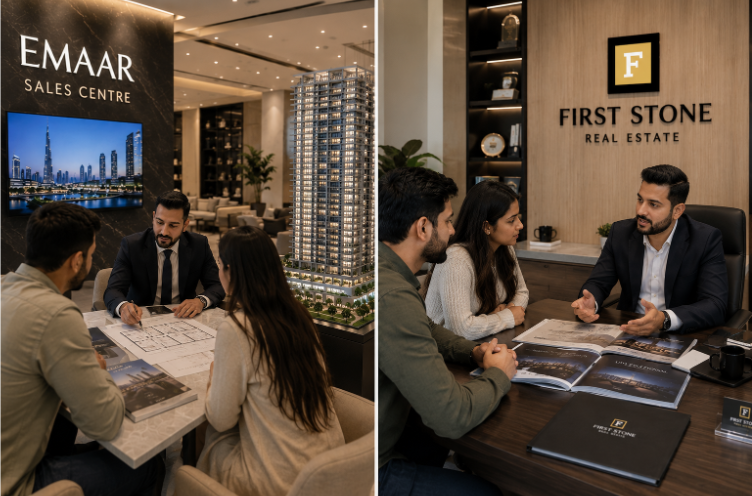
Dubai’s skyline is in a state of perpetual evolution. From luxury waterfront towers on Dubai Islands to family-friendly green master communities in Dubai Hills Estate and Emaar South, the city’s off-plan property sector remains one of the most attractive real estate markets in the world. Investors and end-users from every corner of the world invest billions of dollars into unbuilt projects every quarter. Yet, before selecting a floor plan, reviewing payment schedules, or wiring a booking deposit, every property buyer faces a fundamental choice: “Should I buy the property direct from the developer, or should I hire a licensed real estate agent?” There is no shortage of misconceptions on this topic. Some buyers assume that eliminating the middleman guarantees a direct cash discount. Others worry that real estate agents will charge hefty consultation fees or push low-quality projects simply to earn quick commissions. What is the Difference Between Buying Direct vs. Through an Agent in Dubai? For quick reference, here is how the two buying routes compare across key transaction pillars: Feature / Factor Buying Direct from the Developer Buying Through a Licensed Real Estate Agent Buyer Commission Fee 0% (No agency fees) 0% (Commission is paid entirely by the developer) Inventory & Portfolio Scope Limited strictly to that specific developer’s projects Broad, multi-developer access across the entire market Objectivity & Impartiality Low (Internal sales representatives must hit company quotas) High (Independent advisors evaluate competing communities) Negotiation Leverage Direct discussion with developer decision-makers Handled by the broker; useful for tier-one agency allocations Access to Sold-Out / Pre-Launch Units Direct relationship required with developer management High; top brokerages receive priority allocations & VIP invites Resale & Secondary Market Exit Developers rarely manage secondary resales or flips Agents handle listing, marketing, tenant search, and resale Post-Handover Snagging Support Buyer inspects unit independently against developer standards Professional agents often assist with snagging inspections Best Suited For Seasoned investors targeting a specific developer/community First-time buyers, international investors, and portfolio builders Should I Buy Off-Plan Property Directly from the Developer? Inside a luxury Dubai property developer sales center featuring a large architectural master plan scale model. Buying from an official developer sales center, whether it belongs to master-developers like Emaar, Nakheel, and Meraas, or private powerhouses like Sobha, Binghatti, and DAMAC, is an impressive experience. You are met with massive architectural scale models, virtual reality walkthroughs, and specialized in-house sales consultants. Here is what happens when you purchase property directly from the source. Developer Sales Center │ ├─► Direct connection to project managers ├─► Exclusive first-look at in-house phased inventory └─► Fixed single-brand viewpoint (no cross-market alternatives) What Are the Benefits of Buying Directly from a Developer? Here are some key benefits of buying directly from a developer. 1. Direct Communication with Project Decision-Makers When you purchase directly, there is zero risk of miscommunication between third parties. You deal directly with the developer’s contract administrators, customer care representatives, and CRM systems. Speed of documentation: Sales and Purchase Agreements (SPAs), payment receipts, and milestone verification updates come straight to your inbox without intermediary delays. Direct administrative escalation: If you need an official certificate, payment adjustment, or name alteration on the initial reservation agreement, you deal with the developer’s operations team directly. 2. Specialized Project Knowledge No external broker knows a specific project better than the in-house team assigned exclusively to sell it. In-house representatives know the exact finishings, plumbing specifications, ceiling heights, community service charge projections, and construction contractors working on the ground. 3. Custom Payment Plan Negotiations for Bulk Buyers While retail buyers purchasing a single one-bedroom apartment rarely receive special treatment, high-net-worth individuals (HNWIs) or institutional funds purchasing whole floors, multiple townhouses, or entire commercial blocks carry immense leverage when speaking directly to developer executives. Developers are often willing to tailor custom milestones or waive administrative costs to close high-volume sales. The Hidden Drawbacks of Going Direct While the direct route has undeniable appeal, buyers must navigate several clear disadvantages. THE “BRAND BLIND SPOT” OF DIRECT SALES An in-house sales rep will NEVER tell you: ✖ “The competitor next door offers 20% lower sqft cost.” ✖ “This area has an upcoming supply glut in 2027.” ✖ “Historical capital growth here lags the wider city.” 1. Inherent Brand Bias An in-house sales consultant is an employee of that specific developer. Their job, performance targets, and bonuses depend entirely on selling their company’s stock. They will never suggest that an alternative master community across the road offers better rental yields, lower service charges, or superior public transit access. If a master plan has underlying weaknesses, such as future development potential blocking your unit’s skyline view, an in-house agent is disincentivized to highlight it. 2. The Illusion of the “Direct Discount” The single biggest myth among first-time buyers is: “If I don’t use an agent, the developer will discount the price by the commission amount.” In mature markets like Dubai, this almost never happens. Developers maintain rigid, standardized price lists across their sales systems to protect brand equity and avoid alienating their external broker networks (which drive over 70% of total off-plan sales volume across the UAE). If a developer discounts an off-plan unit for a direct walk-in, they risk destroying their credibility with tier-one agency partners. 3. Zero Support for Resale, Snagging, and Leasing A developer constructs, markets, and delivers property. They are not an asset management firm. Once your keys are handed over: You are responsible for inspecting the property for structural and aesthetic defects (snagging). You must independently find, vet, and contract a tenant. If you decide to assign or “flip” your contract before completion (subject to RERA resale thresholds, typically requiring 30% to 40% paid equity), the developer will not list or market your unit on the open market. 3. The Agency Route: Buying Off-Plan Through a Real Estate Broker Dubai real estate agent presenting an unbiased cross-developer property market comparison to an investor. Using a licensed real estate broker in the off-plan market has become the standard pathway for global investors,

Apartment vs Villa vs Townhouse in Dubai: The Complete Comparison for Buyers and Investors
Choosing between an apartment, a villa, and a townhouse is the single most important decision you will make in Dubai’s property market, and it shapes everything that follows: how much capital you need, what return you earn, how quickly you can sell, and how your family actually lives day to day. The three unit types not just differ in size; they behave like three different assets. Apartments give rental yields, villas are for appreciation and space, and townhouses offer house-style living at an apartment-adjacent entry price. In Dubai’s 2026 market, before choosing a property to invest in, choosing the right category also matters. Quick answer In Dubai, buy an apartment if you want the highest rental yield, the lowest entry price, and the fastest resale. Buy a villa if you want maximum space and the strongest long-term capital appreciation. Buy a townhouse if you want family-home living with a garden and private entrance, without stretching to villa prices. Apartment vs Villa vs Townhouse in Dubai: The Comparison at a Glance Before the details, here is a quick comparison between them. Metric Apartment Townhouse Villa Typical entry price AED 700k (studio) – AED 1.25M (1-bed) From AED 1.1M (entry 3-bed) From AED 2M; AED 4.8M+ prime Median transaction price AED 1.3M–1.55M AED 3M–3.4M AED 7.5M Average price per sq ft AED 1,700+ Between the two AED 1,300 Gross rental yield 7% (up to 8.5% in JVC) 5%–7% 4.5%–6% (sub-4% in prime) Annual appreciation 10%–12% 11%–13% 13%–15% Resale liquidity Highest Moderate–high Lower, slower, thinner pool Share of Dubai stock 70%–75% 8%–15% 7%–10% Outdoor/private space Balcony Small garden + terrace Full garden, often pool Service charges Moderate–high Moderate Lower per sq ft but larger area Best for Yield, liquidity, first entry Families on a budget, balanced ROI Space, prestige, long-term wealth What Is the Difference Between an Apartment, a Villa, and a Townhouse in Dubai? Let’s find out the key differences between apartments, villas and townhouses in Dubai. › Apartment (flat) Apartments are the units inside a shared residential building or tower, ranging from studios to multi-bedroom layouts and penthouses. You own the interior; the building’s exterior, lobby, lifts, and amenities are shared and maintained through service charges. Apartments dominate Dubai’s skyline and its transaction volume, concentrated in dense urban cores like Downtown Dubai, Dubai Marina, Business Bay, and Jumeirah Village Circle (JVC). › Villa Villas are separate properties on their own plot, typically with a private garden, often a private pool, covered parking, and significantly more built-up area. Villas are found in suburban master communities such as Dubai Hills Estate, Arabian Ranches, and DAMAC Hills, or in ultra-prime enclaves like Palm Jumeirah and Emirates Hills. › Townhouse A multi-floor home that shares one or two walls with the units next to it, arranged in a connected row or cluster inside a gated master community. You get a private entrance, your own small garden or terrace, and vertical living across two or three floors, but with shared community amenities (parks, pools, playgrounds) and external maintenance handled for you. Townhouses are like a combination of an apartment and a standalone villa. The structural difference drives everything else. Because apartments stack vertically on expensive urban land, they command a higher price per square foot but a lower total price. On the other hand, villas spread per square foot service charges are lower but far more in total: you’re buying much more space. Side-by-side comparison of an apartment building, townhouse row, and standalone villa in Dubai. How Much Does Each Property Type Cost in Dubai? (2026 Prices) Price is where most buyers start, because it changes the whole strategy. Here’s how the three types line up in 2026. Apartment prices in Dubai Apartments offer the lowest barrier to entry, which is why they have roughly 70–75% share of the market. Typical 2026 averages: Studio: AED 700,000–750,000 1-bedroom: AED 1.15M–1.25M 2-bedroom: AED 1.85M–2.15M 3-bedroom: AED 2.9M A 2-bedroom apartment in a strong location around AED 2–2.5M is also the most capital-efficient route to the Golden Visa with a healthy 6–7% yield. Townhouse prices in Dubai Townhouses occupy the sweet spot between apartments and villas. Entry-level 3-bedroom townhouses start around AED 1.1M, with mid-range units in communities like Town Square, Villanova, and DAMAC Hills 2 landing roughly AED 1.8M–2.5M. The market median for townhouses is closer to AED 3M–3.4M. Villa prices in Dubai Villas carry the highest total price. A 3-bedroom villa in a family community like Dubai Hills Estate averages around AED 4.8M, while the market-wide medians are near AED 7.5M. In prime addresses such as Palm Jumeirah or Emirates Hills, prices start around AED 12M and can exceed AED 50M in ultra premium enclaves. The price-per-square-foot Analysis Here’s the interesting part, the investors miss: villas are roughly 33% cheaper per square foot than apartments. Apartments cost more per square foot because they occupy premium urban land; villas cost less per square foot but far more overall because you’re buying a much greater area. You pay a per-square-foot discount for a villa, but as you buy more area, the overall prices are increased. Property type Median total price Avg price/sq ft Entry point Apartment AED 1.3M–1.55M AED 1,100 to over AED 3,300 AED 700k Townhouse AED 3M–3.4M AED 1,100 to AED 1,400 AED 2M Villa AED 7.5M AED 1,468 to AED 2,376 AED 2M–4.8M Median total price by property type — apartments, townhouses, and villas in Dubai. Which Property Type Has the Best Rental Yield in Dubai? If income is your goal, then pay close attention to this section. Apartments deliver the highest rental yields in Dubai. Across the market in 2026, apartments average around 7% gross (with high-yield communities like JVC reaching 8%+), while villas and townhouses cluster lower. The single biggest divider of yield in Dubai is property type, not location: apartments out-yield villas almost everywhere, typically by 1.5–3 percentage points gross. Here’s the 2026 picture: Apartments: 7.0%–7.15% gross on average; top yield communities include JVC, Dubai Sports City, Discovery Gardens, Dubai Silicon Oasis,

RERA Regulations in Dubai Real Estate: What Every Buyer and Landlord Should Know
RERA Regulations Dubai: Buyer and Landlord Guide Home› Blog› RERA Regulations Dubai RERA Dubai Real Estate Tenancy Law Off-Plan Ejari Buyer Guide By First Stone Real Estate Updated 12 Aug 2026 ~18 min read What Is the Real Estate Regulatory Agency (RERA)? RERA stands for the Real Estate Regulatory Agency. It is the government entity that regulates the property sector in the Emirate, and its authority reaches into almost every transaction, from a tenancy contract to a title deed. The Agency was created by Law No. (16) of 2007 Establishing the Real Estate Regulatory Agency, issued on 30 July 2007. Under Article (3), RERA is a public corporation with its own legal personality and full financial and administrative independence, and it is affiliated to the Land Department. In practice, this means RERA operates as the regulatory arm of the DLD rather than as a separate authority. Together, the two institutions form the base of the RERA rules Dubai applies to the market. The Roles of RERA Dubai Article (5) of the Law sets out thirteen functions. RERA is responsible for the following: proposing the laws that govern brokers and Owners Associations; issuing the bylaws for training and certifying real estate brokers; licensing real estate activities, including development; accrediting the banks that hold developer escrow accounts; licensing, monitoring and supervising brokerages; licensing and supervising property and community management companies; registering and legalising tenancy contracts; auditing and supervising Owners Associations; monitoring property advertisements across all media, including in free zones; advising on property valuation in line with approved standards; publishing market research, statistics and awareness bulletins; and running programmes that explain the rights and duties of everyone in the sector. Article (8) transferred several of these functions from the Land Department to RERA, including the regulation of brokers, the management of escrow accounts and the supervision of Owners Associations. Getting Licensed Under RERA A buyer or tenant does not need to apply for anything, because the protections under the RERA regulations in Dubai real estate apply automatically once a tenancy or a purchase is registered. Professionals are treated differently. A broker or developer must obtain the licence and registration that RERA controls, and the requirements for brokers are set out later in this guide. How Much Can Rent Increase in Dubai? (RERA Rent Caps) A landlord in Dubai cannot raise the rent freely. The maximum increase is fixed by Decree No. (43) of 2013 Determining Rent Increases for Real Property in the Emirate of Dubai, issued on 18 December 2013. The permitted figure depends on how far the current rent falls below the average market rent for similar units. The Permitted Increase Bands Under Article (1) of the Decree, the maximum increase on renewal is set out in the table below. Current rent compared with the market average Maximum increase on renewal Up to 10% below the average for similar units No increase allowed Between 11 and 20% below the average Up to 5% Between 21 and 30% below the average Up to 10% Between 31 and 40% below the average Up to 15% More than 40% below the average Up to 20% The first band is the one most tenants rely on. Where the rent is already within 10% of the market rate, the landlord cannot raise it at all on renewal. The cap only opens up when the rent sits well below the going rate. Article (2) confirms that the Decree applies to every landlord, private or public, including those in special development zones and free zones such as the DIFC. Article (3) ties the average rent to the official Rent Index approved by RERA, so the increase is based on a published benchmark rather than the landlord’s opinion. How to Calculate a Rent Increase The following method explains how to calculate RERA rent increase figures in practice, and it follows Article (1) of the Decree. Find the average market rent for a similar unit in the area using the RERA index. Compare that figure with the rent currently paid. Express the difference as a percentage of the market average. Apply the matching band from the table above. For example, if similar units rent for AED 100,000 and the current rent is AED 75,000, the rent is 25% below the average. That figure falls in the 21 to 30% band, so the increase is capped at 10%, giving a revised rent of no more than AED 82,500. Landlords can use RERA rental index calculator through the DLD channels. It applies the exact bands set by Decree No. (43) of 2013. The Rent Index and the Smart Rental Index Article (3) of Decree No. (43) of 2013 refers to the Rent Index of the Emirate of Dubai, approved by RERA, as the benchmark for average rental value. The Smart Rental Index is the current, upgraded version of that benchmark, used to price a typical unit so the increase caps can be applied fairly. What Are the Dubai Lease Renewal and Notice Period Rules? Before a lease renews, either party may seek to change its terms, including the rent, but the change cannot be imposed at the last moment. Article (13) of the landlord and tenant law, as amended, allows both parties to review the rent or amend the contract before it expires. If they cannot agree, the Rent Disputes Settlement Centre can set a fair rent using the criteria in Article (9). The timing rule is the key one. Under Article (14), as amended by Law No. (33) of 2008, a party who wishes to change any term of the tenancy, including the rent, must notify the other side at least 90 days before the contract expires, unless both have agreed otherwise. This is the RERA 90-day notice period. A notice served later than this is generally not enough to force the change onto the renewed term. Registering Your Lease Through Ejari Article (4) of Law No. (26) of 2007, as amended by Law No. (33) of 2008, requires every
Escrow Accounts in Dubai Real Estate: How Off-Plan Buyer Payments Are Protected
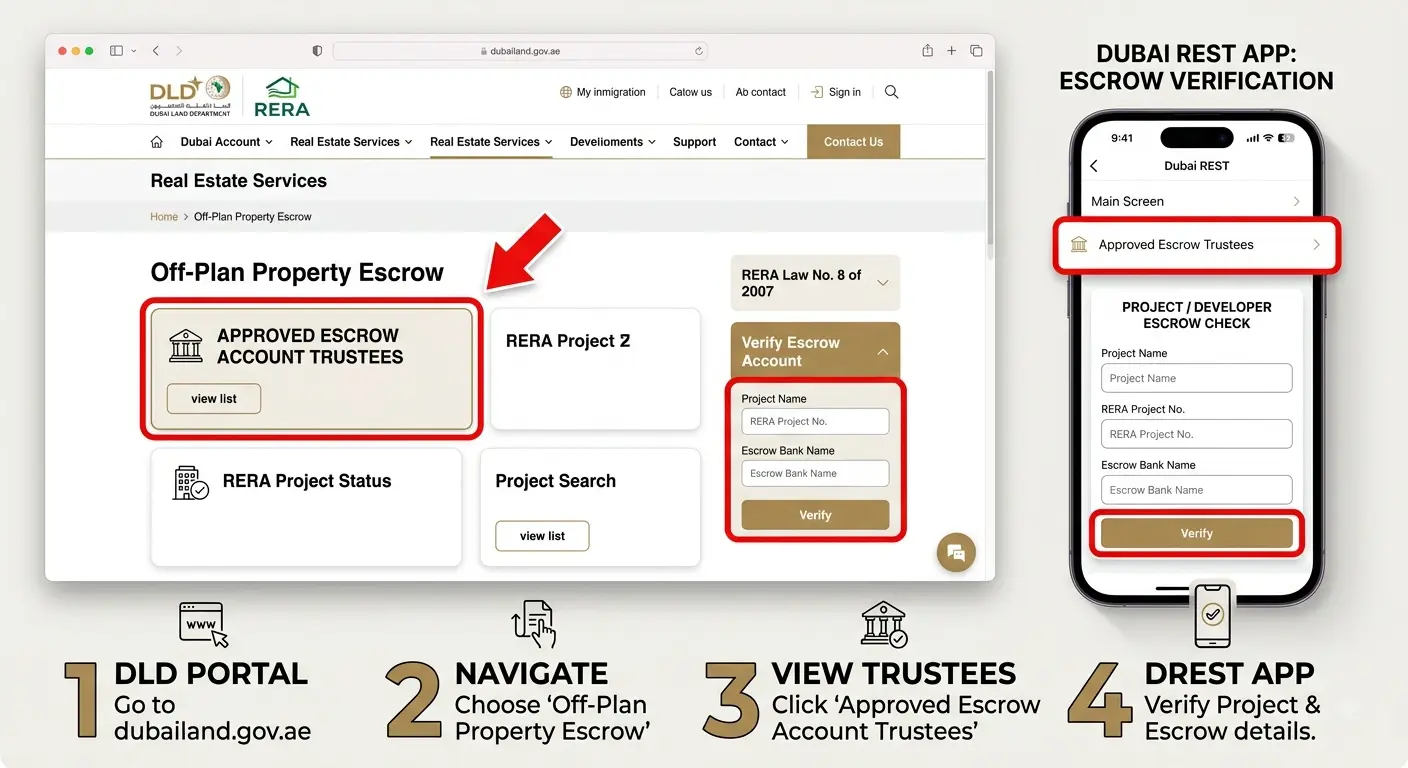
Escrow Accounts in Dubai: A Complete Guide for Property Buyers Quick Answer: Escrow accounts are essential for protecting off-plan property buyers in Dubai. Governed by RERA and Law No. 8 of 2007, these accounts ensure buyer payments are held by a neutral trustee and released to developers only upon reaching verified construction milestones. This secure, government-monitored system prevents fund misuse, builds investor confidence, and provides critical financial recourse, offering significant safety against project delays, developer insolvency, or fraud in the real estate market. Dubai’s off-plan property market is one of the most active in the world. Thousands of property buyers commit funds to off-plan projects every year, trusting that their investment is safe. That trust rests on one legal structure: the escrow account. In this guide, we explain what an escrow account is, how it works in Dubai real estate, the legal framework behind it, and why it matters for every buyer and investor. Table of Contents What Is an Escrow Account? The Escrow Account Law Why Escrow Accounts Are Very Important for Buyers and Investors Allowed Payment Types Through Escrow Accounts How Escrow Accounts Work in Dubai How to Set Up an Escrow Account How to View Approved Escrow Account Trustees Benefits of Escrow Accounts in Dubai Escrow Account Rules for Off-Plan Property Cancellation Difference Between Escrow Account and Trust Account in Dubai Conclusion Frequently Asked Questions What Is an Escrow Account? An escrow account is a secure, government-monitored bank account that holds buyer payments for an off-plan property until specific construction milestones are met. A licensed third party, known as an escrow trustee, manages the account. Neither the developer nor the buyer can access the funds freely. Money is only released when verified progress on site confirms the agreed conditions have been fulfilled. This structure is the foundation of buyer protection in the Dubai property market. The Escrow Account Law Escrow accounts in Dubai are governed by a clear legal framework administered by the Real Estate Regulatory Authority (RERA), a division of the Dubai Land Department (DLD). The key legislation includes: Law What It Covers Law No. 8 of 2007 (Escrow Accounts Law) Mandates escrow accounts for all off-plan real estate developments in Dubai Law No. 7 of 2007 (Land Registration Law) Establishes the legal framework for land registration, including escrow provisions Law No. 13 of 2017 (Real Estate Sector Law) Regulates the real estate sector and enforces mandatory escrow use for off-plan projects Under these laws, every developer selling off-plan units in Dubai must open a separate escrow account for each project before any sales begin. All buyer payments must flow into that account, not into the developer’s general operating funds. The Oqood system (DLD’s online portal for real estate registration) and the TAS system (Technical Administrative System) are used to register, track, and audit every escrow account across Dubai. Why Escrow Accounts Are Very Important for Buyers and Investors The escrow account is not a formality. It is the primary mechanism of financial safety in Dubai’s off-plan property market. For property buyers: Funds cannot be diverted to other projects or used for developer overheads Money is only released as construction progresses, verified by on-site inspection If a project is canceled or abandoned, the remaining funds in the account are available for refund The system provides legal recourse through RERA in cases of developer default or project cancellation For investors: Escrow compliance is a marker of developer accountability Projects registered under DLD escrow regulations carry significantly lower risk Transparent fund release tied to construction milestones protects the value of the investment The system builds confidence in the Dubai real estate market among international buyers Key risk scenarios escrow accounts protect against: Developer bankruptcy Project abandonment mid-construction Misuse of buyer funds across multiple projects Fraud and misrepresentation by unregistered developers Allowed Payment Types Through Escrow Accounts Not every payment can pass through a RERA escrow account in Dubai. Only payments directly linked to the registered off-plan project and its approved payment plan on the Oqood portal are accepted. This keeps fund movement transparent and fully traceable under DLD escrow compliance rules. Payments and Escrow Use Payment Type Escrow Use Notes Initial booking / reservation amount Yes Must match project and buyer record in the DLD system Construction installments Yes Released when on-site progress reaches each agreed milestone Handover payment Yes Paid at confirmed project completion and regulatory approval Certain project-related charges Sometimes Only when listed in the approved project documents Developer operating overheads No Not permitted under escrow rules for off-plan projects in Dubai The Sales and Purchase Agreement (SPA) must reference the escrow account details. If a payment plan directs funds to a separate company account instead of the registered escrow account, that is a warning sign requiring immediate due diligence. How Escrow Accounts Work in Dubai Here is the step-by-step flow of how escrow accounts function in a typical off-plan property transaction: Developer registers the project with the DLD through the Oqood portal and opens a dedicated escrow account for that specific development. Buyer signs the Sales and Purchase Agreement (SPA) or Memorandum of Understanding (MOU) and makes the initial booking payment directly into the registered escrow account. The escrow trustee bank holds the funds and verifies that all deposits match the project’s registered payment plan. Construction progresses and is independently verified through on-site inspections at each milestone. Funds are released to the developer in stages as each verified construction milestone is reached. Final handover payment is processed through the escrow account upon completion of the unit and issuance of necessary approvals. Post-handover, the Defect Liability Period (DLP) may apply, and certain Post Handover Payment Plans may be structured through or alongside the escrow account depending on the project structure. This process ensures that at no point does the developer have unrestricted access to buyer funds. Every release is performance-linked and verified. How to Set Up an Escrow Account Only developers can set up an escrow account in Dubai. Buyers cannot open one directly. Each
5 Best Islands to Invest in Abu Dhabi in 2026
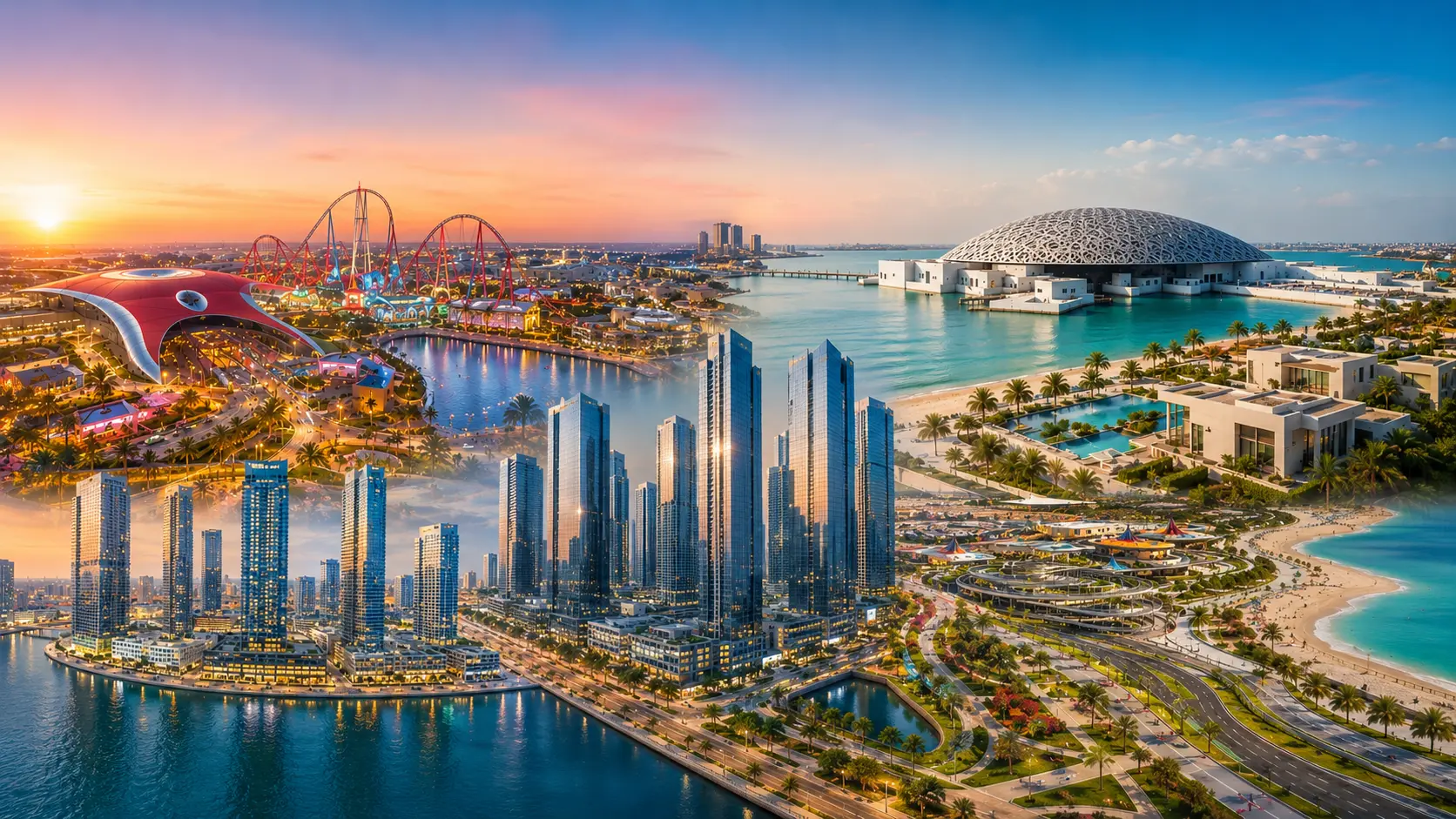
5 Best Islands to Invest in Abu Dhabi in 2026 | Buyer Guide The biggest mistake investors make in Abu Dhabi isn’t choosing the wrong project. It’s choosing the wrong island. Unlike Dubai, Abu Dhabi isn’t a single market. Each island has its own buyer, its own price story, and its own return profile, so the question isn’t where to invest in the capital. The capital closed 2025 with a record AED 73.2 billion in residential sales, up 55% year-on-year, according to Cavendish Maxwell. But that headline offers very different opportunities. Here are the top 5 Islands to invest in Abu Dhabi 2026. Saadiyat Yas Al Reem Al Maryah Al Hudayriyat 1. Saadiyat Island: The Ultra-Luxury Crown Saadiyat is where Abu Dhabi’s wealth concentrates. It ranked first in the emirate in 2025 with AED 13.7 billion in residential sales, roughly four times its 2022 level, according to ADREC data. When ultra-high-net-worth investors invest into the capital, this is where a large number of investors invest. The island is the emirate’s most international market and its largest driver of foreign direct investment. Branded residences set the ceiling here: Four Seasons and Nobu Residences offer a luxury side, while entry-level apartments start from around AED 17,000 per square metre. Villa prices rose about 13% across 2025, and off-plan apartment sales grew a striking 125%, led by projects like Mamsha Gardens and The Beach House. With the Guggenheim Abu Dhabi and Zayed National Museum still in the pipeline, Saadiyat’s cultural pull, and its scarcity of beachfront land, keep the long-term outlook firm. Best for: Capital preservation, branded luxury, and buyers who want a trophy asset that holds value. 2. Yas Island: The Entertainment Hub If Saadiyat is luxury, Yas is a footfall. Ferrari World, Warner Bros. World, and the Yas Marina F1 circuit are already here, and the confirmed Disney theme park, expected to open in the early 2030s, has made the entire island on every investor’s radar. The numbers back the momentum. Yas recorded the sharpest apartment price growth in the emirate in 2025 at roughly 18%, with apartment rents climbing around 23% over the same period. That combination is why Yas is widely considered Abu Dhabi’s best area for short-term and holiday rentals, with yields typically in the 5% to 6.5% range and entry villa prices that stay more reachable than Saadiyat’s. Best for: Short-term rental income, holiday-home investors, and anyone betting on tourism-driven demand. 3. Al Reem Island: The End-User Magnet Al Reem is the island where people actually live. Reem Mall, Central Park, premium schools, and offices are all inside the island itself, which is why it consistently posts one of the highest apartment transaction volumes in the capital. Apartment prices here rose around 17% in 2025, close behind Yas. For investors, the appeal is liquidity and yield rather than luxury headlines: rental returns commonly is in the 7% to 8% range, and the depth of end-user demand makes units easier to rent and easier to exit. Together with Yas, Al Reem accounted for close to 40% of total residential sales volume across the emirate. Best for: Steady rental income, first-time investors, and buyers who prioritise liquidity over prestige. 4. Al Maryah Island: Abu Dhabi’s Wall Street Al Maryah is the capital’s financial district. In December 2025, Mubadala and Aldar announced a joint venture worth more than AED 60 billion to develop the island’s final undeveloped landbank, nearly 500,000 sqm on the north side. The scale is what makes this one hard to ignore. The expansion will deliver over 450,000 sqm of new Grade A office space, effectively doubling the island’s commercial supply, plus more than 3,000 new luxury waterfront residences. It’s like the Wall Street of Abu Dhabi, already hosts more than 11,000 active licences and close to 40,000 professionals. Major brands & government offices like FAB, Four Seasons, AGDM, HSBC, Rose Wood are here. Branded homes like W Residences and The St. Regis are already in the pipeline to meet that demand. Best for: Long-term capital growth, investors who understand that corporate demand drives residential prices, and those buying ahead of a district’s maturity. 5. Al Hudayriyat Island: The New Emergent Hudayriyat is a landmark mixed-use waterfront development in Abu Dhabi, bringing together sport, leisure and luxurious coastal living in one master-planned community. In the first quarter of 2026, it recorded roughly AED 11.97 billion in transactions, the highest of any residential destination in the emirate that quarter, overtaking both Saadiyat and Al Reem. Villa prices on the island grew about 27% over the same period, among the strongest appreciation anywhere in the capital. What sets it apart is that the lifestyle is already built. Surf Abu Dhabi (the world’s largest wave pool), a UCI-standard velodrome, 16 km of open beaches, more than 220 km of cycling tracks, and the emirate’s largest urban park are operating today. The island’s signature move is architectural: hilltop villas built on man-made hills rising as high as 45 to 60 metres, delivering 360-degree views of Abu Dhabi and the Arabian Gulf. Developed by government-backed Modon, most units clear the AED 2 million Golden Visa threshold. Best for: Lifestyle-led buyers, sports and wellness demand, and investors chasing appreciation in an early-stage, low-density market. How to Choose the Right Abu Dhabi Island The islands don’t compete so much as serve different goals. Matching the island to your objective is the whole game: Want luxury and capital preservation? Saadiyat. Want short-term rental income? Yas. Want steady yield and liquidity? Al Reem. Want long-term financial district growth? Al Maryah. Want a lifestyle with strong appreciation? Al Hudayriyat. In Abu Dhabi, the project matters less than the postcode. Choose the right island and the rest of the decision gets a lot easier. Browse live listings and price trends across all five islands on First Stone Real Estate to see which one fits your investment goal. FAQs Which is the best island to invest in Abu Dhabi in 2026? It depends on your goal. Saadiyat leads